From My Journal – Character Sketch

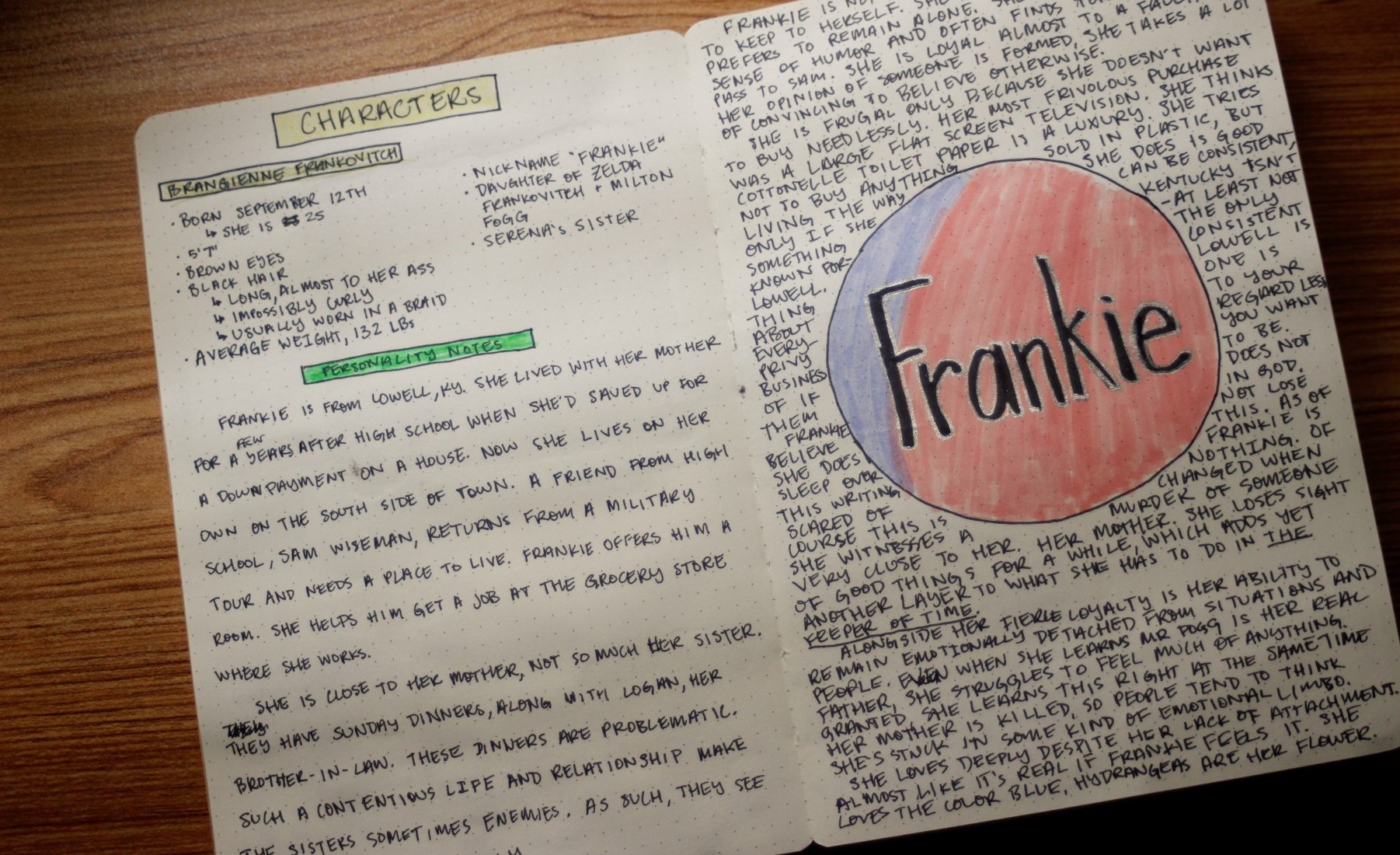
This week, we’re going into my world building journal and taking a look at the main character of my Maker trilogy, Frankie. There are a lot of traits in her that I have myself, but that’s the truth of almost all writers. Injection of our best and worst qualities feels like the thing one does when one tells stories.

Brangienne “Frankie” Frankovitch

  • Born September 12th, at the time of the story, she is 25 years old.
  • 5’7″
  • Brown eyes
  • Black hair (long, almost to her hips, impossibly curly, usually worn in a braid)
  • Average weight, about 132 pounds
  • Daughter of Zelda Frankovitch
  • Sister to Serena Shorn

Frankie is from Lowell, KY. She lived with her mother for a few years after high school when she’d saved up for a down payment on a house. Now she lives on her own on the south side of town. A friend from high school, Sam Wiseman, returns from a military tour or two and needs a place to live. Frankie offers him a room. She helps him get a job at the grocery store where she works.

She is close to her mother, not so much her sister. They have Sunday dinners, along with Logan, her brother-in-law. These dinners are often emotionally explosive between Serena and Zelda. Such a contentious life and relationship makes the sisters sometimes seem like enemies. As such, they see each other infrequently.

Frankie is not an overly loud person. She tends to keep to herself. She isn’t anti-social, simply prefers to remain alone. She has a very dry sense of humor and often finds terrible jokes to pass to Sam while they’re supposed to be working. She is loyal almost to a fault. Once her opinion of someone is formed, she takes a lot of convincing to believe otherwise–both in a positive and negative way.

She is frugal only because she doesn’t want to buy needlessly. Her most frivolous purchase was a television. She thinks Cottonelle toilet paper is a luxury. She tries not to buy anything sold in plastic, but living the way she does is good only if she can be consistent, something Kentucky isn’t known for–at least not in Lowell. The only thing consistent about Lowell is everyone is privy to your business regardless of if you want them to be.

Frankie does not believe in God. She does not lose sleep over this. As of this writing Frankie is scared of nothing. Of course this changes when she witnesses a murder of someone close to her. Her mother. She loses sight of good things for a while, which adds yet another layer of what she has to do in The Keeper of Time.

Alongside her fierce loyalty is her ability to remain emotionally detached from situations and people. Even when she learns who her father is, she struggles to feel much of anything. Granted, she learns this right at the same time her mother is killed, so people tend to think she’s stuck in some kind of emotional limbo. She loves deeply despite her lack of attachment. Almost like it’s real if Frankie feels it.

She loves the color blue, and hydrangeas are her favorite flower.

The Girl Who Said Goodbye

This week we’re doing something a bit scary for me. I don’t often share my writing publicly because it’s often something I consider too personal. Good approach if I want to get published one day, huh? Anyway, this is a piece I’ve worked on off and on for a little while. It’s about death and the afterlife, so if that is something you find troublesome, please skip this post. Otherwise, I hope you enjoy it.

A dry hacking sound tore through the house. From under the covers on a crumbling bed, a papery hand reached for the glass on the table, fingers trembling on its smooth, cool surface. Empty. Frederic knew it was, but with everything, he’d forgotten. He coughed again. A fit overtook him and if he could have crawled to the bathroom to spit the blood, he would have. Sunken with age, his chest heaved as he tried to get a full breath of air. The coughing died to a steady wheeze with each shallow pass.

Something clattered on the stairs. Fear froze his stomach. He cried out, a pathetic, weak sound, and covered his face.

Someone burst into the room, shattering the warped wood of the frame. A woman with matted and tangled black hair staggered in. Paler than a sun bleached mouse skull. Her coat, an army green thing, shredded to her elbows with strips of mangy fabric dangling as she searched the room. She dug into the pocket of her khaki colored trousers, a small notebook in her hand. She flipped through it as she studied the room, nodding to herself. Her eyes landed on the lump on the bed.

At first, Frederic thought she was there to rob him. She certainly looked the part. No shoes. Tear stains left salt crusted trails down her cheeks through the dried muck smeared on her skin. He watched her as closely as his tired eyes would let him. A quiet beep made her check her wrist. She looked at him, her eyes suddenly clear, a bright green piercing him with kindness. She smiled and the fear left him.

“Will you open the curtains?” Frederic gestured to the window. His voice cracked like dry leaves on a sidewalk. “The curtains.”

She shook her head. When she spoke in English, his shoulders seemed to sink into the mattress further. Her eyes closed and she tipped her head back, as though trying to remember.

“Je suis desole,” she said, her accent marring the fluidity of his language.

He nodded and pointed, the weight of his arm almost crushing his chest. “Please.”

She went to the window and waved at the heavy fabric. “Oui?”

He nodded once more. She pulled one side over, and then the other. A sigh deflated him.

“It has been three days since I’ve seen them, the stars.” He tucked his hand under his cheek and smiled, his watery blue eyes bright. Tears slipped over his nose, but he didn’t bother to wipe them. “I have not seen–“

She sat on the bed by his knees as he wept what was left of his tears. The sound of his dying filled the silence. No death rattle, simply weary breathing. The woman remained on the edge of the bed for a while after he inhaled one last time.

She wasn’t ready for the next part. She never was. With a shuddering sigh, she shook herself from her head to her toes and cracked her knuckles. The soul was in there, waiting. She could feel it radiating from just below his ribs. Not quite the stomach, but just above it.

“Let’s get you home,” she whispered and stroked his cheek.

Her body trembled as she looked into the ceiling, her eyes going completely white. Offering a quick word of what could have been a prayer, her form shifted into an ethereal translucence, making her look almost dead herself. She plunged her fist into his chest. If she’d been solid, she’d have snapped his ribs. But she didn’t need a body for this.

One more deep breath and a hard yank. She held his soul, its tendrils spilling over the palm of her hand, trying to fill the body below once more. She gently folded it together and eased it into her satchel. She touched his forehead, a sad smile on her cheeks. His eyes remained open. He’d been without the stars long enough.


The woman, Gabriel, clambered down the stairs, her form solid again. She made sure to leave the door open, something she always did for those like Frederic. Pausing, she looked back up at the bedroom window. She blew him a kiss as she backed out of the front gate, past the delphinium and hyacinths, the tall wild grass choking the fence. She sent one more kiss his way, and waited, her hand at her throat, as though she could stop the weeping behind her teeth. She wiped her nose on her dirty sleeve and stepped off the curb in front of the bus speeding toward the city.

It caught her as it always did and she swung herself up onto the roof. Flattening against the cold metal, she let herself become translucent once more, part of the heat emanating from the warm bus inside. A shimmer passing by. She held her satchel closer, remembering the man she held. Hoping they’d find him soon.

Fifteen minutes later, she let herself slip from the rooftop and land on her feet beside a bus stop. She plopped herself down on the bench and sighed as she rubbed her eyes. Getting back to the underworld wasn’t the difficult part, but she always hated the sensation of leaving behind part of herself every time. A few deep breaths later, she clenched her fists and gave over to the pull all souls feel from the beyond.

It dropped her at the entrance, similar to the way grand hotels looked from the inside, the afterlife’s way of giving the departed a peaceful sendoff. She pushed open the door and stepped onto the street. The hazy gray light bounced off of empty, dilapidated buildings. Her feet knew the way, and she let herself get lost in her thoughts as she made her way to her final destination.

She loved them, those creatures she carried. They represented the good of the world she’d left behind all those years ago. Her task to give the souls their last bit of love before they rejoined the stars in the underworld sky made it less challenging. Often she’d be whisked from place to place, though. Too many died alone, and she couldn’t let that happen.

But she found them. All the same. She found them at each and every bedside, each broken bridge, the crumbled stairs in buildings long abandoned. They wandered without someone to hold them in, those souls, never straying too far, however, from their bodies. Just in case.

Gabriel knew she had the job no one else wanted. It was most difficult on a day with suicides, car accidents, and stillborns. But she treasured those souls a little more. Carried them in special paper she’d designed from the sea kelp to keep them from getting crushed by the others in her bag. Some of the gatherers didn’t like souls. Found them too alien. Smoke monsters, she’d heard them called. But there was nothing monstrous about them.

They all mattered. Every single one of them. Who else would show them a final act of kindness before they left? Certainly, she was lonely. No one talked to her much after they learned how long she’d been assigned to this task, how she asked to be left on it. The veterans accused her of enjoying the death. The loss of life.

It was quite the contrary, of course. Gabriel felt the life in each soul she emancipated from its husk. The joy. The sorrow. The anguish, the moments of love—all of it. Purer than the way a baby smiled at her mother for the first time.

The smell of salt made her lift her head. She turned down a side street and kept going even past the brick wall blocking off what lay beyond it. Special privilege for gatherers and all. She pushed through a heavy gate, the rusted hinge finally cracking off—salt water made short work of that. No one came here. Not anymore. The monocrhome waves of the TV static left bitter aftertastes in their mouths.

She sat slowly at the edge of the water, a grimace smudging her face as she scooted closer to the sea. It hurled itself at her.

It knew of her prize.

“I know, I know,” she said, petting it like a cat. She opened her satchel and pulled out the soul. Shaped like a dome, it wobbled in her palms, going dull in the black and white of the shore. All souls did. She blew on it a little, the tendrils floating when she stopped.

The sea waited. She lowered her cupped hands into it. As soon as Frederic’s soul touched the static, millions of others lit up the sea all the way to the horizon. A low hum resonated in her chest as he drifted away, the water like seltzer on her toes. She smiled.

If your bones be heavy things,
lay yourself down at my feet.
I will bring you safely home,
wherever it may be.
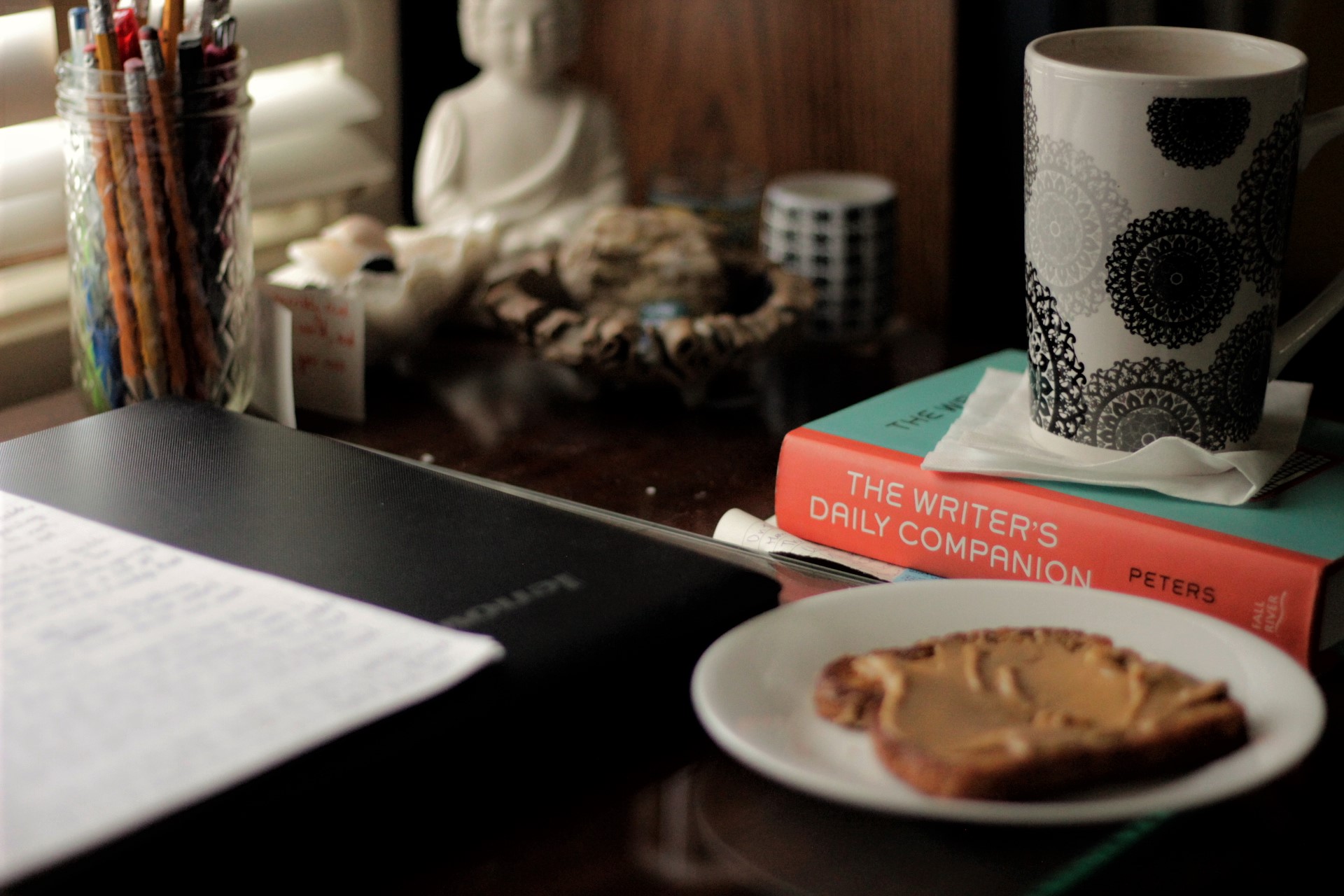
How I Write – Workspace

At a desk, the kitchen table, sprawled on the couch, propped up in bed, the dashboard in my car on a lunch break, under a tree at the park, in full view of people so they can see me writing: I’ve done it all. I’m sure you can tell from the title that this post today is all about my creative workspace. I have a couple, and they’re all in the same room, so let me talk to you about them.

When I was house hunting last year, one of the requirements was 3 bedrooms. Not because I have a family or plan to have one, but I wanted a guest room, and an office. Most of my life I’ve never had the space to feel free to make a metaphorical (or literal) “creative” mess. I’ve either confined myself to my bedroom to write, had my desk available, but it functioned as a holder of other things and less like what a desk should be, or I’ve had to use the kitchen table. This isn’t a problem because it’s a lovely thing to have a kitchen table you then have to clear away so you can use it for food. But I still wanted more.

So, when my realtor showed me this house, the master bedroom fit my visions of the perfect space. When I moved in, my sister helped me paint the back wall “Delft pottery” blue, and I’ve been putting up all the things that inspire my creativity. A signed poster from my favorite singer/songwriter, Zac Hanson’s scribble on a piece of notebook paper I had in my bag, Dried flower, my sister’s artwork, a photo of my niece’s foot she took herself, a map of Middle Earth from a very dear friend, and more yet to come. (I’d post a photo of this wall, but I also have photos of my friends and family and I don’t want to expose them to the internet outside of Facebook).

I fully believe in having a dedicated space to be productive. Whether it’s writing or other creative projects, I think it’s important to have a place your brain automatically knows “it’s time to work.” I’ve got two spaces for working, both in the same room, so when I come in here, my mind switches to productive mode. Whether I’m sitting at the art space or at my desk for writing, I am able to focus on the project I want to get done. Today it happens to be a blog post and afterward, I’ll be working on typing up the stuff I’ve written recently (that process is another discussion).

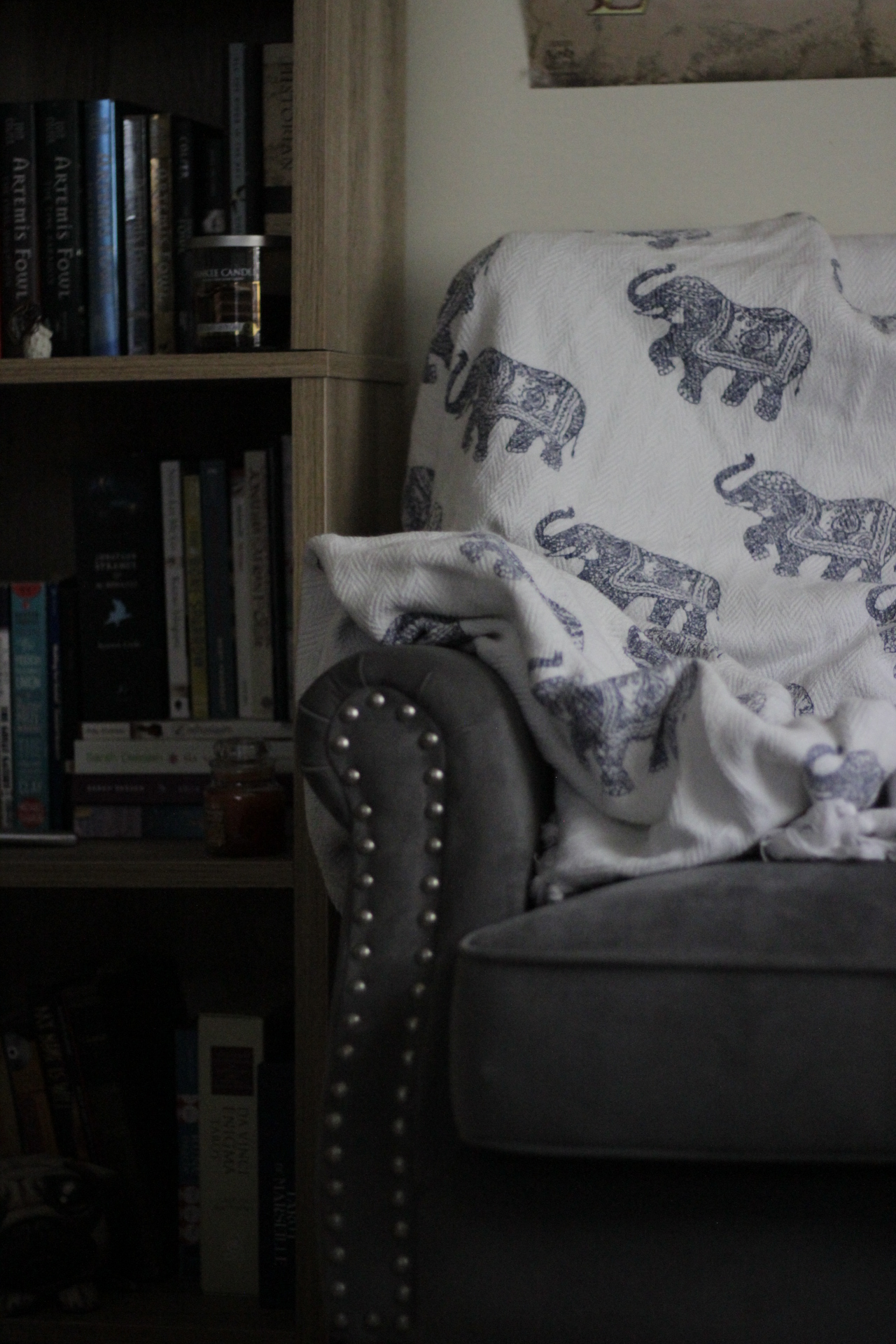
Of course, creativity isn’t limited just to the things I can put on paper. It’s also about growing my mind through reading and visuals. Which brings me to the wall opposite my desk, the one behind me right now. I have my small library set up, and I got an accent chair to curl up in and read.

The last place I have in my office that I was going to try and post a photo of (but WordPress is having a moment, so I won’t this time) is my photo “studio.” It’s really just a half-closet with a card table and some fabric backdrops that I pin to a bulletin board. I mostly use sunlight for now, but one day I’ll have actual lighting for those times I don’t wake up at the sparrow fart of dawn for a good photo.

Sometimes when I think about the life I have now, I wonder if I deserve it, and I think the answer I’d get is a resounding yes from the people who matter to me, and while I appreciate their support and love, one day it’d be nice to believe that for myself. Allowing myself to feel proud of the house I’ve been turning into a home, my home, that’s not narcissism no matter how much my brain tries to tell me it is. It’s important to have places that make you feel like a person, like a worthwhile person. Surrounding yourself with what helps you feel creative, productive, peaceful, that’s important.

I’ve finished my coffee, and I’ve eaten my toast. I’m going to get to work on the day’s projects. Until next time, friends.

How I Write — Worldbuilding Journal

As I was deciding the topic for this week’s blog post, I realized I haven’t really shared much about what I’m working on in my own writing life. I’m not overly secretive about it, but I do tend to shy away from sharing because I struggle with showing people “unfinished” work. There is truth to the saying, “it’s never going to be truly finished,” but I take that a little too seriously sometimes. Here’s a very brief summary of the main plotline of my series, as well as a small peek into how I keep it all organized.

I’ve mentioned maybe once or twice that I’m working on a trilogy. It’s lumped under the main title of The Maker Series, with really pretentious titles for each book. The first book, Fulcrum, is the introduction to the story. We meet most of the main cast, leaving a few surprises for the second book. We meet the main character, Brangienne Frankovitch. She goes by Frankie. I get a lot of grossed out looks when I say her name, but I chose it a long time ago, and calling her something else would be a lie. She’s from a small made up town in Kentucky, and she’s revealed to be the chosen one. Yes, it’s a cliche story, but she’s not a teenager! She’s actually 25 years old, working a really chill job as a grocer’s assistant (she stocks, she runs the registers, she unloads deliveries, she’s everything except a manager). She lives with her best friend, Sam Wiseman, in a house she purchased two years out of high school after choosing not to go to college. Sam is a returned veteran of the armed forces (or so he says), and when they run into each other at the store while he’s buying food, he tells her he doesn’t have much going for him. She invites him to come live with her.

It turns out, Sam is not Wiseman, but Bayn, and he is a soldier, but not for the world Frankie knows. He’s from a place called Amaranth, and he’s a member of a private security firm sent to be her protector. Protect her from what, I hear no one ask? The Moarteans. See, when the world began, time had already been happening for a while. We were more of an experiment devised by those who created time. The Thrice Unbound created the First Four, who in turn had Milton Fogg and Tobias (no last name, he’s got the Beyonce vibe going on). Through some shenanigans, the two boys cause an all out war between themselves, and in order to settle things down, the Thrice Unbound allow them to each create a world. The one Milton Fogg creates is our world, our time as we know it. The one Tobias creates is called Telaroth (renamed Lazarus after some stuff goes down there). Tobias devises a way to rewrite the DNA of all his male citizens to turn them into sort of super soldiers (called? Moarteans). He’s doing this because he wants to destroy Milton. In the course of things and a lot of bad stuff happening in Telaroth, later Lazarus, it becomes apparent that his way of life is actually decreasing his chances of survival, and thus: Lazarus is born.

Frankie learns all of this, and is then taught how to fight (because it’s one of those stories, you know? She has to learn to fight). She loses family. She loses friends. She loses parts of herself, literally, because the Makers (the people of Amaranth) also have a way to change DNA. Never one to be emotional, Frankie has intense feelings rear up in a way she’s not had to deal with before, and with that comes anger, defeat, and hopelessness. The friendships she does make along the way keep her grounded, but she will, of course, never be the grocery girl from Lowell ever again.

The second book is called The Keeper of Time and in it Frankie learns the truth about all things, about how she’s been bamboozled. She’s been coerced into a fight that shouldn’t even be happening, but here she is. She goes on a sort of spirit quest to find herself (and a character vital to the end game–it’s a road trip book, I know, cliche, but hey! quests are important to life. Whether it’s to the gas station for drinks with your best friend at 2:30 in the morning, or to find a broken priestess wandering the metaphorical desert, a journey is a journey is a journey). She also finds herself in the hands of someone she wasn’t prepared to see ever again, someone she thought was a distant memory (not a romance, lawls). By the end of the second book, with further trauma to add to what happened in the first, Frankie returns to Amaranth to find it in an uproar. A militia has been formed and people are ready to storm the castle gates, in a manner of speaking. Frankie can’t convince anyone of the reality of the situation, so she escapes into Lazarus.

Which brings us nicely to the third and final book, Lazarus Rising. I’m aware of the biblical implications here, but the larger metaphor is the only association to the Bible story of Lazarus. I don’t want to go into too much summary here because I want to hold this one as close to my heart as I can. It’s the end of the ride. The last bus stop. The culmination of nearing decades of work. Frankie faces incredible challenges, often left with more questions and more bruises both physical and mental. But she is resilient. She prevails in the face of her torture. For a time. Maybe. Am I being mysterious enough?

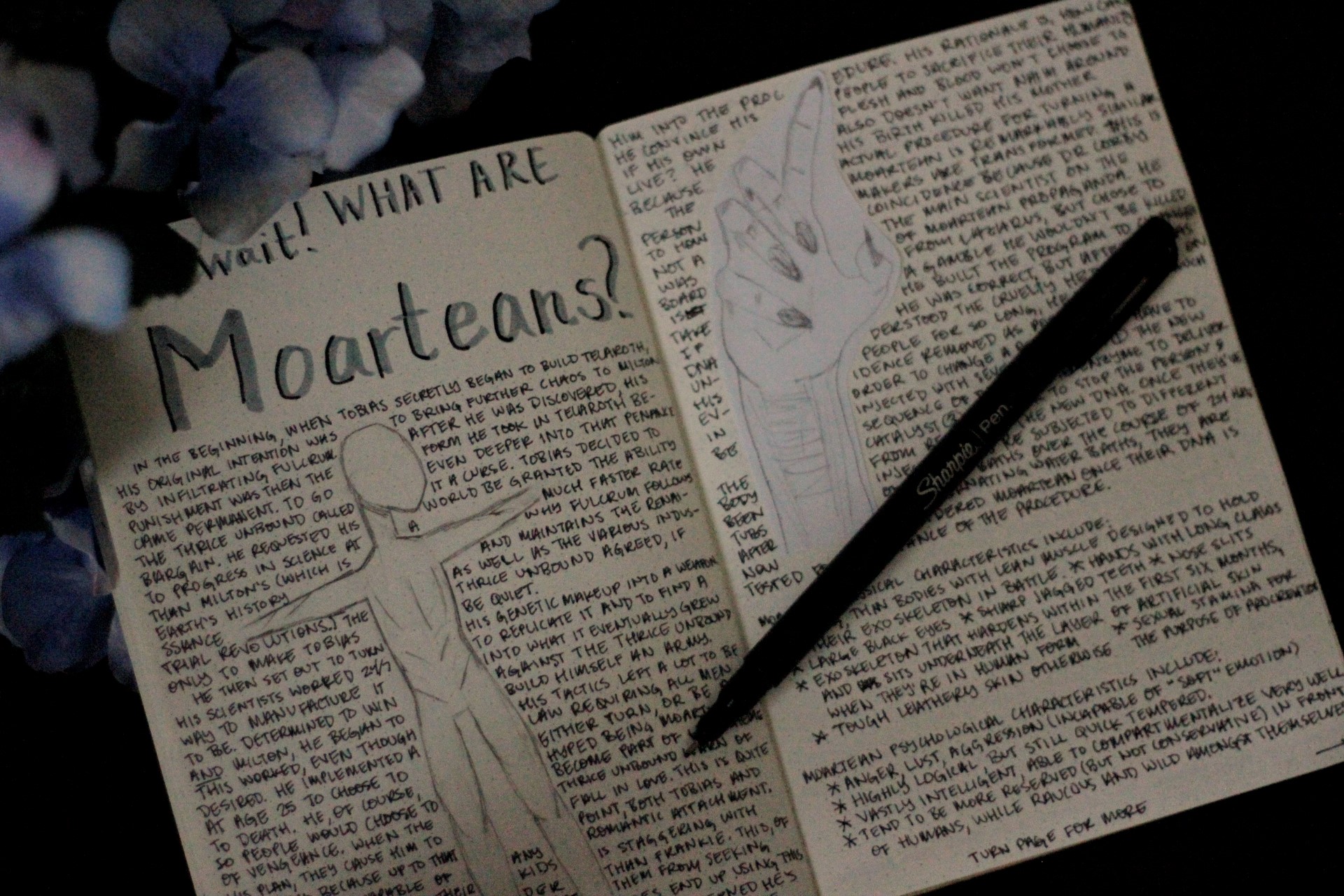
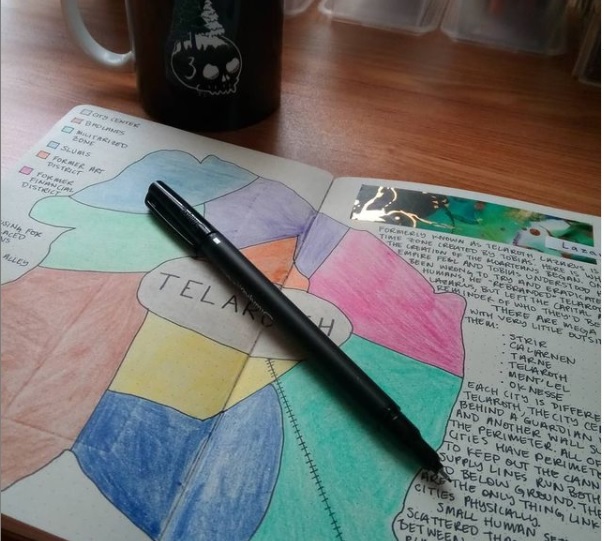
The world of the Maker series is a complex one because technically there are three separate places: Fulcrum (our world), Amaranth (also known as The World Between Worlds), and the “alternate reality” of Lazarus (formerly known as Telaroth). The easiest way to keep track of all my thoughts on this came about in the form of a journal. I’ve been compiling notes on characters, settings, and all kinds of other things, and eventually the language of the Moarteans will be housed in the journal (yes, I’m going the extra Tolkien mile by creating a language). A snippet or two of the journal is included in this post, but it is by no means complete. So far, I’ve gotten spreads done for all the characters (from all books), and now I’m working on getting the settings down.

Setting is more than a place, which is obvious, but bear with me. When I started working on the pages for Lazarus, it struck me I’d never committed anything to paper about who the Moarteans are. I’ve done rough notes for previous drafts, but the race was never really part of the story except for a few instances. This became an issue fairly quickly because the third book takes place almost entirely in Lazarus. I’ve never gone into who these people are, and now I’m planning an entire book with them? Part of why I began the worldbuilding journal was so I could have a designated place of reference. I know there are apps and programs that help writers sort things into their proper places, but I’m a far more visual person, so I needed to feel the place as I wrote it down. I needed to be the ball so to speak.

By giving myself the opportunity to physically create the Moarteans (on paper, anyway), I’ve allowed myself to fully immerse in the world I’m hoping readers will enjoy. This is not by any means the way I’d recommend people work out their worldbuilding. What I’ve chosen to do suits how my brain functions. I think I mainly wanted to showcase, finally, what I’ve been spending so much of my free time on the last little while. It’s a handy reference tool. It will house everything there is to know about my books in one place. As I’m getting ready to end this blog post, I’m already planning on spending some more time working on my journal tonight.

Find what makes you soar and fly, my friends.

I Feel That: a small opinion piece on Emotive Writing

I was going to do a book review today and while I do intend to post book reviews on here eventually, I had a discussion with myself the other day while I was watching some stuff. First, I’m not an expert, so please don’t take my words as true advice. Second, it’s important to develop your own thoughts on how you approach writing. I see on writing forums the endless thread creations of “should I be a writer?” “How do I start writing?” “What makes a good writer?” And the eons of variations. Writing is so subjective. There’s no right or wrong way to do it. Not everyone is going to want to read your work, and that’s actually preferable. Then you can get a perspective from outside those who appreciate your style. It can help you grow as a writer and a person to hear from people who don’t necessarily jive with your jimmies. There are limits, of course. People end up being rude just because they can, and those people don’t matter to your growth. You are worth exploring your interests and you are capable of separating the shit from the shine.

So, that disclaimer/weird pep talk out of the way, let’s get going. I think a lot of people are faking emotion, or presenting something in a way that’s emotional without having the reality of the feeling behind it. Hold on, we’ll get to why, but let’s be real here. With the amount of distractions and the way the world is these days especially, not many people are able to tell the difference between what they’re feeling and what they think they’re feeling. If we’re not paying attention to ourselves, we can start to associate certain things with feelings instead of actually just feeling the feeling.

This might sound confusing, so let me try and go a bit further into it. Two things I came across recently for this: a video about how a singer wasn’t able to actually emote the feeling behind the lyrics of the song, and an episode of Criminal Minds from the earlier seasons. In the video with the singer, the commentator said it sounded like he was trying to make it sound emotional. “There’s something that comes across as very thought through. . .it’s about the dynamics of the singing. It just seems like he’s trying to make you feel something instead of feeling it and getting it out there with his vocals.” (Semi-quoted from this video here: https://youtu.be/ddUBW9Ms0mA link opens in a new tab) While he’s talking about a song I secretly like (don’t come at me, Justin Bieber can really sing when he puts his mind to it), he’s 100% accurate. Maybe there are some preconceived expectations of Mr. Bieber because of his history as a person, and perhaps we’re not really sold on how true this song is to him because of that. That idea is a completely different post, however, so let’s move on.

I’m not putting a spoiler warning here because Criminal Minds has been out for over 15 years and so if you haven’t seen it, that’s on you, not me. In one of the seasons, a character, Elle Greenaway, gets shot by an unsub (unknown subject–cute, yeah?) and while she’s in surgery, she sees the light at the end of the tunnel and her deceased father is waiting on the private jet to take her to heaven. It sounds like it would be an intense, emotional moment, right? But it wasn’t. Maybe it’s how the actress did her job, or maybe it was the writing of the scene, but it fell flat and pissed me off because it was forcing me into an emotional moment I didn’t believe in. This is also a pretty common trope in television series, but within the same series a few seasons later, Aaron Hotchner is in the hospital fighting a wound/scar tissue issue, and he sees his murdered wife and the guy who killed her. This was a far better use of the trope because we’d had time to learn about Hotchner and we’d had time to appreciate him.

All of this leads me to the topic today, emotive writing. I’m not talking about books that make you ugly cry, not completely, but I’m talking about writing that makes your readers feel something other than “I am here reading this book.” When I think about my favorite books, they’re designated as such because I usually had an emotional response to them. Again, not the kind that made me cry. Tana French’s In the Woods is a mystery and the entire time my anxiety built and by the end, I was ready to never set foot in woods again because of how intense the emotion was. The Green Rider series by Kristen Britain is one of my favorites because I have an emotional connection to the main character as she does her best to help keep her home safe. Through her challenges and failures, I am invested in what she does. I feel like I’m right there with her as she fights off the bad guys. Neil Gaiman plays into the part of me that still tries to be a kid full of wonder because of how imaginative his writing is. He grabs onto that and runs with it so by the end of the book, I’m ready for another adventure.

I think it’s impossible to list all the ways writers can work emotion into their stories, but the idea is it has to be genuine. It has to be real and honest. If we’re writing a death scene for a beloved character, have we really given the audience time to invest in them enough for this death to matter? Or are we playing on what we hope they’re bringing with them to the reading? This is getting a bit into some literary theory, which one day I might do a series of commentary on that, but for now, I think trying to reconnect to the characters we’re writing, the stories we’re telling, that’s what we should focus on. Yes, writing for a market is always the driving force, but even while doing that we can write for ourselves, too.

When I get too bogged down by “this plot doesn’t even exist” or “how many times has this person looked at someone with a glare” or “I’ve used these words too much in the last twelve pages,” I remind myself of this: remember why you started.

But Carla, that’s such a silly thing to think when you’re telling me to be more emotive in my writing. Is it? Why are you writing the story you’re working on, then? Is it because you got excited to tell it? You … felt … excited? Hmm? That’s a stretch, and I know it is, but there’s a level of truth to it. We write for ourselves first, and then the audience later. We’re telling stories we want to share, and if we don’t believe in them, you can sure as the wind blows bet your readers won’t either.

If you made it this far, thank you. I hope it wasn’t too disorganized and wordy. Stay safe and good luck to you and yours during the upcoming holiday season.

Romance Novels are Dangerous

Bear with me. I’m not about to go trashing a genre that makes billions of dollars. Very clearly it’s a market people want and are all about. But I do want to discuss it a bit.

Let’s take a moment and think about what romance novels are at their core. They’re meant to be distractions. Fantasies about what we want, or think we want. There’s lust. Not a lot of actual romance before we get to the end, and somehow the main characters are in love and ready for their future together. It’s one of those things where we expect to be entertained without going too far into why we’re entertained. It’s time to break into that a bit.

My biggest issue is that the genre presents lust as love, without considering the impact of leaving out the love that gets left behind. Potentially. We don’t really get to see much of that past a happy ending. It’s all wrapped up. Nice little package. But love isn’t always happy. And I’m not talking about the overly drawn out dramatic confrontation that comes right before one of the protagonists realizes that the other is all they’ve ever needed in love. I’m talking about the fact that eventually the quirks that draw you into a partner sometimes might become annoying and not so cute anymore. The nights when trying to be a household feels like an impossibility because you’ve got your own habits, and they have theirs.

Romance novels all have the same basic plot, too, in what I’ve seen from the ten I read in preparation for this post. Boy and girl meet, have a spark, they can’t stop thinking about each other, there’s something holding one of them back from fully accepting feelings, they have wild sex multiple times, one thinks they’re not good enough somehow for the other, big dramatic event happens, the one who tried to leave realizes just how much they love the other, rush to find them/save them/tell them, they get married, and the woman is usually pregnant by the end of the story.

This isn’t a bad plot. But after reading so many in a row, it got tedious. The man is usually incredibly wealthy, completely ripped and fit, handsome as hell, and a loner of some sort. Bad boys are even better. The women are curvy in the right places, but still manage to have a trim waist. Long hair with perfect waves. Career or family driven, never both (there was one rare exception I read), weeps beautifully. The standard impossible people. Some of the main character traits for the men were a bit disturbing. The women consumed their every thought and lives until it was all they could do not to see them. I know the feeling of being in love for the first time with someone and it’s rather difficult to tear one’s mind away from a new love, but the level of . . . intensity and dedication was borderline obsessive. They were overly protective, actively committing violence against a perceived threat to the woman they claimed to love. Jealous. Almost abusive.

The women are typically submissive, even when they’re described as being take charge and full of vivacity. They’re still dominated by the men in the stories, which tells me there’s not much originality in the thought that goes into these things. They’re also consumed by the thought of the man, usually after they’ve had wild sex that stays on their mind for a few days until they can do it again. They snap at the characters around them until one of their friends says something like, “you haven’t been yourself lately, what’s up with that??” and there’s a realization that the woman is in love. But she can’t be in love! They only just met! How could she possibly have feelings for someone she just met? /sarcasm

The level of superficiality in most of these relationships is incredibly off putting to me. There’s not much substance to back up the supposed feelings of the characters. The chemistry they’re meant to have just doesn’t exist. Typical story: they’ve known each other for years, haven’t ever done anything about it, friends pit them together and suddenly they realize they’ve been lacking for seventy years.

What I want from romance novels is reality. I know that doesn’t sell, and maybe I’m an outlier here, but what good are these novels if they perpetuate problems? Women are the main target audience for these (I unfortunately don’t have enough experience reading any LGBTQ+ romance to have an opinion on this, especially when there are others who are much more capable of discussing that topic), and while I appreciate the attempt to have books designed specifically with women in mind, it makes me question what the actual gain is here, and what authors believe women really want.

Sure, the sex scenes are hot. But is that really all the novels are for? I feel like I might be missing the point of these novels. You might be wondering why I’m so interested in this, and the reason is because I’m in the process of writing my own. I read quite a few last weekend all in the name of research, and it discouraged me from wanting to proceed because of how vapid the whole thing is. And maybe that’s the point! That they’re strictly for entertainment purposes, which is fantastic. They are pretty entertaining. But as a reader, I want something more than just a kinky moment in someone’s bedroom. It feels disingenuous and like I’m looking in on something I shouldn’t be. I’m well aware there are plenty of softer romances out there–I read those when I was younger, hoping for inspiration that way–but it still leaves much to be desired in my opinion (no pun intended?).

I think I’ll leave this here for tonight. I do have more to talk about when it comes to characterization problems I have, but that’s a different post entirely, I think, because it’s less related to romance novels. If you made it this far in my ramble/rant, thank you. I would love to have an actual discussion about this kind of thing with writers to see if I’m not quite catching the purpose of this genre. It would be an interesting conversation.