How Do People Do This?

I received the author copies of Daisy I ordered, and I opened the box a little too enthusiastically. Holding copies of my books in my hands is such a strange feeling. Strange because I think it might be pride, and I’ve never really allowed myself to feel that before. I did just find a typo in it, but ya know what? I don’t give a fuck. This book I put together entirely by myself, and I’m not perfect.

When I was first working on Fulcrum, I didn’t have a printer that functioned, so I asked my mother if I could use hers. She agreed, and I printed out around 70 pages of the first “real” draft of Fulcrum I felt was actually going somewhere. I was holding it in my hands, staring down at the words, and I kind of said to myself, “I wrote this.” Then, I smiled and I looked up at her and I said a little louder, “I wrote this!”

“And I printed it!”

Instant deflation. I couldn’t have one thing for myself. One of the few times I allowed myself to feel pride, and she ripped it away from me.

Not anymore, though. I’m trying to give myself the gift of being proud of myself for the things I accomplish, and typos or not, I am proud of Daisy. I know I wrote about how it was a struggle to get this one done, and I’m not trying to say it wasn’t, that the end product is overwriting (hah, get it?) the struggle to get here. But I think I figured out why it was such a challenge for me to finish this one.

Ellie’s story is deeply personal to me. Author inserts and all, setting that aside, I understood her character in a way I don’t understand the others I love dearly. I’ll never be a chosen one, bound by destiny to save the world like Frankie, but I have been an abused child. I still have this lingering feeling of “don’t tell people, they don’t need to know. Don’t tell them so they know what she’s really like. Let them love her as she wants to be seen.”

I still love my mom. I love her painfully. It’s painful because I see mothers behaving and being the way I wish mine had. I accept her as she is, I accept that we will never have what I need from her. But no one can ever say I don’t love her.

Maybe it’s because this is exactly a year after the last big holiday I saw her that I’m feeling really sentimental, and seeing a finished book about a character I actually was is unleashing grief I refuse to feel. Or maybe it’s the insomnia that’s got me by the balls, leaving me overly sensitive to big feelings because of sleep deprivation. I don’t know.

But what I do know is how very proud of myself I am for telling Ellie’s story, and giving her a place to exist in the world. I don’t ever promote my shit, much to the befuddlement of others, but I’m of the mind that my words will find those they’re meant to. Ellie is probably the truest character to my heart, and I feel kind of like a parent watching her kid go to school on the first day of kindergarten. Out into the world to become herself. Be what she wants to be.

I’m rambling. I’m tired. It’s a holiday, and I am grateful for you. Thank you for reading my wombles. Thank you for being part of the world at the same time as me, because you make it just as neato as I do.

Until next time, friends.

Writing Journal #15

Another short update this week.

I’ve released Daisy into the wild. It’s listed on my publications page if you wanna see the final cover and stuff. I’m very much a minimalist when it comes to cover design, and this one is definitely minimal. There’s no summary on the back, and the front is just a flower and the words “a novel” centered on it. The title and my name are on the spine, so it’s not like… a complete mystery. But yeah. Daisy is done.

My November Writing Thing is currently at …. some number of words. I’m 293 away from my goal for this week. I’m contemplating letting myself miss goal since I was working on getting Daisy finished up. I can make it up easily, too. I’m a little less than halfway through to my final word count goal, and I don’t know where I’m trying to go with it entirely. But that’s the beauty of storytelling. It gets figured out along the way.

I’ve decided after I finish writing this piece (currently titled Simon Says), I’m going to gently encourage myself to take a break from writing. I don’t know how well that will go because I must always be giving the world words, but as I’ve finished up my Daisy work, I’ve come to realize I devote a lot of physical energy to a book and I don’t really ever tell myself to slow down.

I have a folder of short story ideas that I’m looking forward to getting into for next year, and then of course there’s the third book of the Maker series, Lazarus Rising. That’s going to be a fun time. I mean that. I kind of went through the first draft a bit, about halfway through for some random edits, and I genuinely enjoy being in that story. It’s a home I created for myself, I think. If I could live in Lazarus, my goodness. It’s one of those situations I wish I could link up my brain to a visualizer and show you what it looks like in each of the cities so you could see it the way I do.

But therein lies the other joy of storytelling. I get to show you with my words.

I had something else to talk about, but I’m currently working on typing something up for a friend, and my wrists are a little sore–OH! Instead of writing the rest of the year, I’m going to be reading. I have two books I want to finish before the end of the year, and then whatever else I happen to come across on my shelves will be a delight. I don’t remember what my current total read is for the moment, but I’ll do a “books of the year” post either at the end of December or the beginning of January.

So, this isn’t a short update, but I got a little sentimental, I suppose. I was thinking about how I made a promise to myself to utilize this website more and I think I’ve done so. It’s been nice to put my thoughts somewhere I know someone might see them. I appreciate the readers I have, and I appreciate the consistency in which y’all see the innards of me noggin.

And with that, I sign off for now. It’s not the end of the posts for this year, but it might be the end of the posts for November. We’ll find out! I hope you’re well. I hope your words taste good, and I hope you remember it’s never too late to tell a story.

Until next time, friends.

Writing Journal #12

Mornin’, folks.

I’ve been, as I told a friend, almost neurotic in trying to get this book done. I finished marking up the manuscript a… day ago, and I’m already on chapter eleven (this morning) with going through to fix things. If all writing were this fast, I would get more done, I think. I did spend about an hour and a half last night before bed reading through Lazarus Rising.

That one I’m pumped to get back into. I forgot how dastardly Mr. Fogg is, and as I was reading through his sections, I kind of forgot I wrote him and just “man, this guy.” So that was fun.

I’m possibly going to have my summer project, aka Daisy, ready by the end of the month, and I wasn’t going to do a big release of it, but I think I might just announce the completion and be all “hey, here it is.” I’m only going to do a print version of it, I think.

I wrote out a list of the front matter I need for this one (the bits in front of the book, for those who don’t know the lingo I didn’t know until I finished Fulcrum), and I definitely think I’ll put a content warning in. It’s not smut on the romantasy level, but there are some descriptive moments. It’s one of those things where I kind of … It’s necessary for character development in this case, like, very necessary, which is the only reason it’s been put in. And the descriptions are there for the characters and how they’re feeling/experiencing things. I hope I did it well. I am going to take one scene out because it is gratuitous, and I think that’s very editorial of me, haha.

I’ve had Daisy in my head since high school, and I never really thought I’d finish it because it just kind of sat for a few decades. It’s got many, many iterations. I’m pretty sure this final content version is in the teens in terms of drafts for it. But that’s the beauty of being a writer. You grow and life experiences color and graft onto your writing style. What I knew in high school is useful, but I’m able to parse through the stuff in my brain far better. Well, maybe. That’s a different story for a different page.

At the end of the day, I’m proud of this book and the story within it, even if I felt like it was an undertaking now in my thirties versus my late teens, early twenties. Maybe my thoughts about love are a bit different, too. Actually, no maybe about that one. I joked around with some friends that I hate love, and then said I don’t, and one of them said back “don’t lie to my face.” I don’t hate it, I just don’t think it fits me right now. I love it for other people, though. Which I think is why this project has kind of been a lot for me to work on.

Good news for me, though, because once I finish this, I’ll never write a designated romance novel again in my life, haha. I will leave that to the professionals, and if there’s romance in my other stories, it won’t be the focus. It’ll be a side quest.

That’s all the shoes on this rack, kids. I hope you have a lovely weekend and I hope the fall air is crisp in ya lungs as you go about your day.

Until next time, friends.

Writing Journal #10

A list:

  • On chapter 18? 19… of my Summer Project (It’s called Daisy, but I keep referring to it as my Summer Project to … appear more mysterious? I don’t know)
  • Gathered a list of short stories that I think I could possibly put together in a collection
  • Went through a few chapters of Lazarus Rising’s first draft (Fogg is so fun to read and write)

I spent yesterday reading 2.5 books, and both were disappointing. I don’t know why I keep expecting romantasy to be good. It’s all miscommunication tropes that make me want to slam my face in a blender. And if it’s not that, it’s the main couple arguing about their relationship. It’s so frustrating that the plot is non-existent in a lot of these. But if the people want the fuckin’, I guess they’ll get the fuckin’.

I’m going to spend some time typing up a bit of the first scribbles I made of The Dust Chronicles. A story I keep drifting to in my heart. It might be a duology. It also might just be a single novel. But a fuckin’ big one. That’s the next project after the Maker Series.

That’s all the snow on this mountain. I hope you are doing well. I hope the summer has been kind to you, even if it’s been hot as balls.

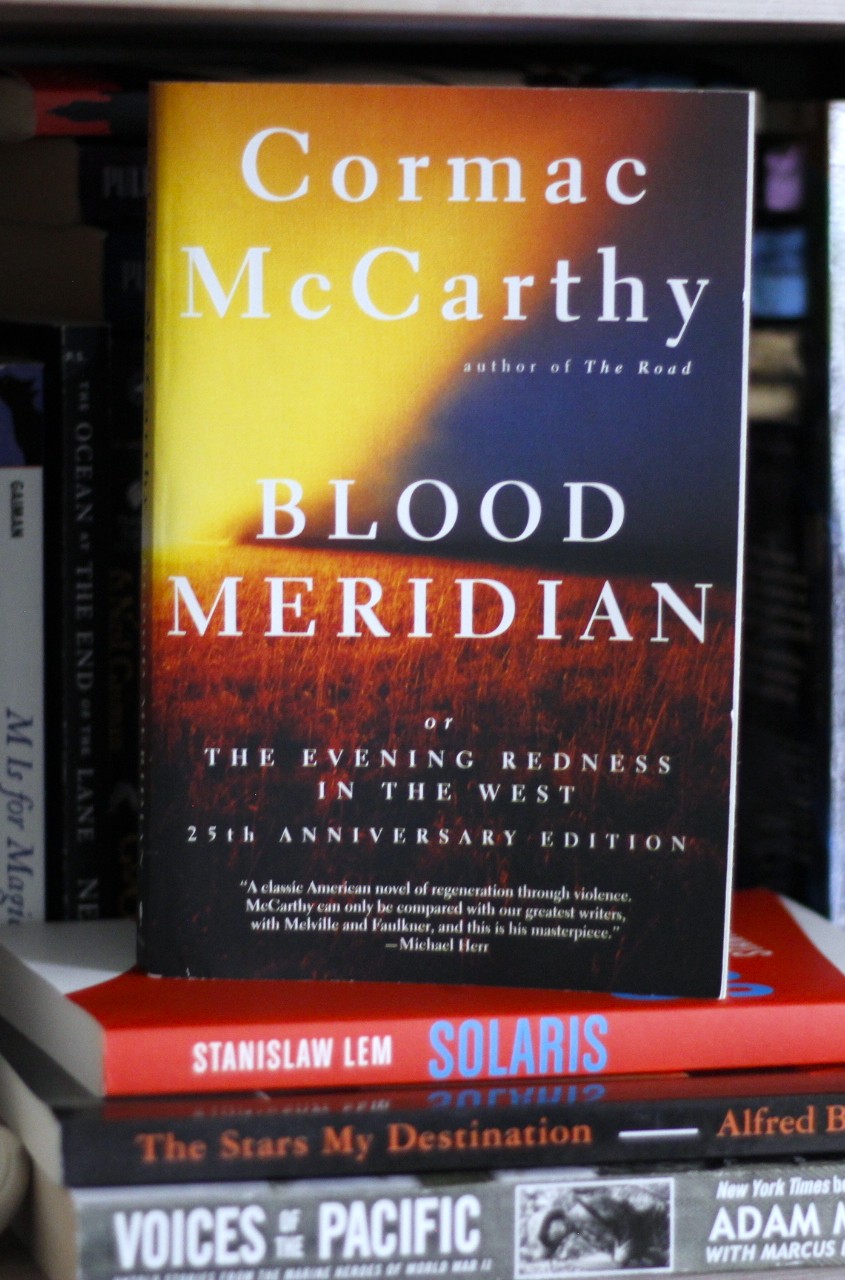
Blood Meridian by Cormac McCarthy

“If God meant to interfere in the degeneracy of mankind would he not have done so by now? Wolves cull themselves, man. What other creature could? And is the race of man not more predacious yet?”

I was 102 pages in when the violence finally made me pause. It was a long pause. I don’t usually annotate books I read, but this one I started underlining and writing in margins (in pencil, as I’m not an entire heathen). My note on page 102-103 is, “this is the first instance where the violence struck me. Up until now, it’s almost been a desensitization, but the nonchalance of Glanton and the visceral description of the woman’s death is such a stark interjection within the sleepy atmosphere.”

Glanton, the person I’d consider the main antagonist of this book (although others would call the Judge the antagonist, but we’ll get to him), kills this old woman by pointing one direction, and once her head’s turned, he shoots her point blank. Before this moment there are dozens of descriptions of violence, but it is the taciturn way in which Glanton takes this life that caught me so abruptly I had to step out of the story for a few days.

I read this whole thing slowly.

I needed to take my time with it because of a few things, but the biggest reason is how comfortable with the violence I got while reading. It’s a morbid lullaby, the way it weaves in and out of the ride through the untamed West. It seeps into your bones as you read, reminding you that you are part of it.

It brought me back to how I felt about Tender is the Flesh last year, where I felt like I’d been the one to do the killing.

Page 142: “The leaves shifted in a million spangles down the pale corridors and Glanton took one and turned it like a tiny fan by its stem and held it and let it fall and its perfection was not lost on him.”

My note: “Glanton noting the perfection of a leaf is such a stark contrast to him killing the old woman a few chapters ago.”

That is where I decided Glanton was the villain of this book. A man without true empathy wouldn’t be able to recognize the absurdity of pondering the machinations of a leaf while having spilling innocent blood.

Page 184: “They passed through small villages doffing their hats to folk whom they would murder before the month was out.”

My note: “How many people were killed during this time? How many forgotten because no one was left to remember them?”

McCarthy is an acquired taste. He’s known for his rambling passages and infatuation with leaving punctuation out of his life. He has wisdom in his words, but sometimes it’s so buried within the mire of his writing style that one has to attempt multiple readings.

This is not a book to read twice. It left me feeling heavy and empty at the end of it. All the violence, for what? To prove he could get away with it under the guise of literature? It’s very much a book that people say they love because it makes them sound and feel edgy. Like they’ve seen some things, man.

Not everything needs to be a contest of sufferings.

There’s such an absence of emotion from most of the characters as they go around killing for their government. Getting rid of the people there before them. It leaves a sour taste all through my digestive system as I try to empathize with any of the riders in Glanton’s crew. The one I could not find any sort of understanding for was the Judge.

He and Glanton are made for each other in their insensate glorification of the blood they spatter. The Judge is the metaphor for the Devil, I assume, although I would say he’s the one who acts on behalf of the Devil, who as I said before is Glanton. But the darkness inside the Judge is a level that had me react physically to several of the lines he said.

Page 207: “Whatever exists, he said. Whatever in creation exists without my knowledge exists without my consent.”

And shortly after on page 208: “The freedom of birds is an insult to me. I’d have them all in zoos.”

In all the books I’ve read in my life, there are two villains I’ve come across: the broken and the batshit. The broken ones, I’d toss Glanton in that category. He’s got a smidgeon of humanity in him because even though he doesn’t care what happens to the men on his crew, they are his crew and he treats them with a modicum of respect.

The judge is the one I’d put in the batshit category. He says some of the most unhinged garbage I’ve ever read, and he says it with such an authority behind it. Like he knows that someday someone will find what he’s spoken and will choose to live by it. He believes himself invincible. One has to be crazy to truly believe that, right?

There is a plot to this book, somewhere. What it is, I don’t know that I could say it’s linear. It’s more of a character study, where the Kid is placed in unbearable circumstances right from the beginning. It’s a test of who we really are at the end of whatever day. Do we stand by and allow ourselves to be swept into the current of hell racing toward us? Or do we fight that flushing of refuse and black bile back? Do we dig our feet into the earth and demand that darkness do its worst?

We do not have to be heroes, but we have to be able to look at ourselves at the end of this romp through the meadows of life and say we were our truest selves. That no one ever made us compromise on who we are for safety. For the luxury of silence.

7.5/10

*******I read the 1992 First Vintage International edition*******

Writing Journal #5

I don’t necessarily have writer’s block, I have lack of interest in writing at the moment. I’m still trying to write, though, and so some of the stuff that comes out is useable and other bits are more scrappable.

I am not discouraged by this, though! Sometimes taking breaks is necessary. Give a brain a bit of a rest. I’m doing some reading, though. Currently I’m reading Blood Meridian by Cormac McCarthy, and The Temptation to Exist by E.M. Cioran. I may review one or both of those! May also just read them, haha.

I considered doing a game review of a game I recently watched a playthrough of, but I sometimes feel like a poser when I try to talk about video games. I’m not skilled in the slightest at playing them, so I usually watch games (without commentary). Big, big space horror fan.

Back to writing: I’ve done a few things with the language I made up for the Maker series, like named a metal and started … doodling? I guess would be the word for it, but seeing how sentence structure would work. Different cities would have different structure sometimes, I think, as a way to differentiate their cultures/accents/etc.

I think that’s about all I have in terms of an update for now. Until next time, friends.

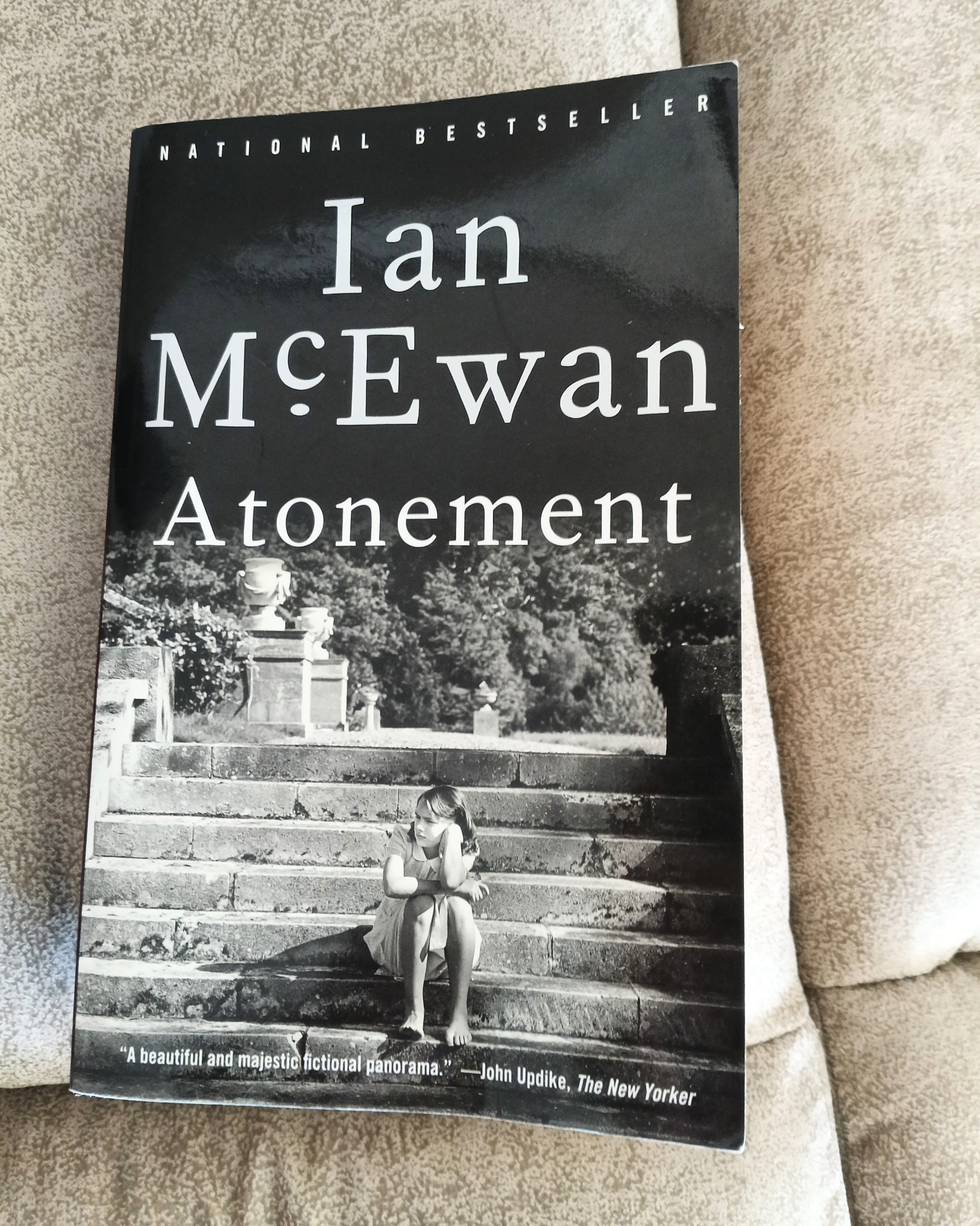
Atonement by Ian McEwan

“It wasn’t only wickedness and scheming that made people unhappy, it was confusion and misunderstanding; above all, it was the failure to grasp the simple truth that other people are as real as you.”

I had this book sitting on my “I’ve read this” shelf and recently went looking for something else when I spotted it. It sat on my “I haven’t read this” shelf for a while because I knew the story already. I’m a big, big fan of the film adaptation of this book, and from the synopsis, it followed the story pretty accurately.

I was not prepared for how deeply beautiful this book is. In the beginning, it’s told from the perspective of a thirteen-year-old girl who misunderstands something she sees out a window. A few more things happen within the space of an afternoon and evening, and as a result of her incorrect assumptions, lives are shifted into irreversible directions.

The film follows the book nearly scene for scene, which I felt incredibly kind of Hollywood. The story is rather important in all its moving parts, as most are, but with something so delicately perched on the bevel of catastrophe, anything left out would render the whole thing meaningless.

In reading some of the reviews, there were several people bothered by the fact the main character, Briony, doesn’t seem to “grow up” over the course of the book. This mainly stems from how she interrupts the rape of her cousin, and because of her false accusations sends an innocent family friend to prison.

The book stays mainly in Briony’s perspective, so we see her grow into a young adult at the precipice of a country at war. She doesn’t take her place at Cambridge, and goes into nursing–like the sister who fled the family on the arrest of the family friend. Briony comments on knowing she was wrong in her youth, and several of the reviewers were upset the rape isn’t discussed past a certain point.

My response to that is why would Briony talk about something that didn’t happen to her? I don’t mean that to sound callous, but as someone who’s experienced sexual violence, I don’t really find it pleasant to discuss. I don’t think the few people who know the situation sit around and talk about it amongst themselves either, so placing a responsibility on the main character to go into such an experience feels a little beside the point. She does eventually attend her cousin’s wedding, and it’s revealed her cousin marries the man who raped her (very much not the family friend). That and a few things Briony says at the end of the book are the only time it’s really mentioned again.

I don’t find it her responsibility to process such an event. McEwan could have written Lola’s perspective into the book, but she wasn’t a main character, and so having her show up to think/talk about her experience would have disjointed the story entirely.

The other thing people commented on was how the whole situation wasn’t important enough for a book. To that, I say, they missed the point. No one wants to read about a wealthy family crumbling because of misplaced accusations and a war. Not truly. But the depth of perspective we get from Briony shows us how penance cannot be achieved perfectly. By the end of the book, she is an old woman and discussing her regrets, so to speak, and what I love so much about it is the vast scope of her understanding, and the pain she has at not having her sister in her life.

I know my opinions are not the right ones. But they are mine, and I see Briony as faulted, someone who caused tragedy and bore the weight of that tragedy the rest of her life. Some would say rightfully so, but I feel like those people forget what it was to be thirteen and not understand the world the way we see it as an adult. We know right from wrong, but if we don’t know the reason or the why for something, it’s hard to articulate the responsibility.

9/10 stars

*******I read the First Anchor Books 2003 paperback edition*******

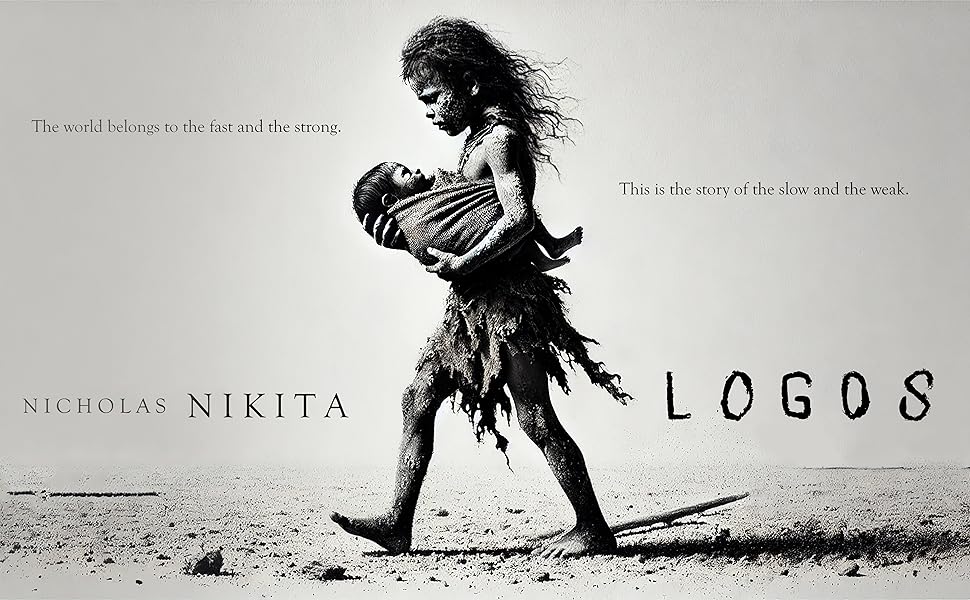
Logos by Nicholas Nikita

Image taken from Amazon.com e-Book

First read of the year and it’s a dang doozy. I found this while browsing the genres in Kindle Unlimited and the premise intrigued me enough to pop it in my library. It was a quick read in that I was able to read it in a few hours. The time it took me to read it should not detract from the quality of the story being told.

Logos follows an unnamed boy for the majority of the book as he survives a primal land. He loses his parents to the night-beasts, and saves his newborn brother. The first part of the book covers the brothers purely surviving the harsh landscape as they travel to the mountains, where the eldest believes their parents are waiting with the sun god, Aeos. It shows the desperation of people simply trying to live, where water and food are dangerously scarce. The boys are attacked by men and beasts over the course of their journey, and when they finally reach the mountains, the boys are old enough to be considered young adults (or that’s how I read them to be). Lightning strikes a tree and starts a fire. This fascinates the boys and they cultivate the fire, feeding it so it stays alive. The youngest convinces his brother to keep it large enough to be a signal to others in the vicinity, hoping their curiosity about the light and smoke will bring people to them.

The rise of this community is such a fascinating look at how socialization works. The boys are considered gods because they can hold the fire (on a stick, without burning their hands), and they can carry the fire. This sets up a dichotomy between them where the eldest becomes the more determined to build solidarity, to have sameness. Make sure people can speak the same language, ignoring the fact he’s bulldozing over other languages and practices in favor of his own creation. The boys are given names, Leos (the younger) who wears the skull and fur of a lion he killed, and Ra who wears the skull of an eagle (or some other large bird) he battled.

There is an inevitability toward the end I won’t spoil, but what I liked so much about this was how clear the progression of understanding and coherent thought became as the story went on. The boys grew into men and their minds became their own, and that strong characterization showed how even when the world is full of unknown dangers and death, the more their minds worked, the more the world made sense.

I don’t feel as though I’m properly explaining myself because it felt like recognizing something from before, like there’s an inherent desire to be. The brothers went in different directions with their curiosities and understandings of the same world they were presented. The eldest had far more experience in the danger than the younger, and so his was caution until it became maniacal. The youngest had the innocence of curiosity unfiltered by those experiences.

I think this was a solid book to start the year off with, and I recommend it. It is rather dark and depraved in places, but I found that added to the primitive nature of the world in which the brothers lived. When one exhibits too radical a deviation from the comfort of routine, the other offers a balance and a command to return to familiarity. By the end, it’s a book about a boy trying to do the best he can for his little brother. It’s a deeply thought provoking book. I give this 8/10 stars.

Books of 2024

I figured why not start with a bang and go into the books I either liked the most or had a lot of thoughts about in 2024. My grand total of books read was 93. I did not, in fact, finish reading The Fires of Heaven by Robert Jordan like I promised my brother I would, but we’ll get into that later. The books I’ve chosen for this list are the ones that stuck with me throughout the whole year. Most of these I read months ago, and some I finished far earlier in the year, and they still stick with me.

1. Tender is the Flesh by Agustina Bazterrica
I feel like I need to say that if you are not the kind of person who reads heavy topics, this is not the book for you. A lot of the reviews I read of this said that it was disgusting and horrific and I feel like they missed the point of it. This book is not one to enjoy, necessarily. It’s one to make you think way too deeply about the state of humanity. It is a plunge into how people treat others, and that is such a superficial approach to it. It’s societally accepted cannibalism. There are humans bred specifically to become meat for other humans to consume. There are laws in place to “protect” the meat, and there are other things surrounding the “rights” of the ones being used to feed the masses. It’s told from the perspective of a production plant manager (I don’t remember his title officially) who’s dealing with his father going through Alzheimer’s, and a host of other issues both personal and professional. I will say that by the end of this book, I felt like I’d participated, and if you’ve read it, you know what I’m saying because the ending just left me bereft for a few days. I immediately recommended it to some of my friends. It is a purposeful calling out of people who mistreat others and also a scathing commentary on how society is structured. I gave this book 9/10 stars.

2. The Man in the High Castle by Philip K Dick
This book is on the list because it disappointed me and I’m still thinking about the ways it did and how it could have been better. I’ve not read any of Dick’s work before, so this was my introduction, and I was left wanting. He presented this incredible “what-if” scenario and then left it to the imagination for most of the events happening. So much of it occurred “off-screen” and I found that incredibly lackluster for such a stunning approach to alternate history. Especially since it’s for WWII, which has been a topic of debate ever since people realized they could theorize about the “what-ifs” of history. I started reading it because I watched the first episode of the show of the same name, and this is one of the few times I’ve uttered “the visual media is better than the book.” It gives substance to the ideas Dick presents in his book. It shows us the battles, the intrigue that’s hinted at within the subtleties of the writing. I’m glad I read it so I could see what it was, and I’m glad I watched the show (haven’t finished that yet) to expand on what the book could have been. I gave this 5/10 stars.

3. Everwild by Neal Shusterman
The second book of the Skinjacker trilogy by Shusterman made this list because it was the one that stuck with me the most. I think one of my favorite things about Shusterman’s storytelling is he invents new ways to approach death, which is such a difficult topic for anyone to discuss, but especially young adults. I do think sometimes the romances are a little unfinished and rushed into, but if that’s the only critique I have of his writing, I’d say that’s all right. I don’t know if it’s my appreciation for his writing that makes his books appear on my “that’s my favorite” lists, but there is something about his approach to illuminating the dark places of sadness that keeps me personally afloat when I could very easily sink. The trilogy as a whole is a stunning tale of lost children, and some of the ways they “go into the beyond” left me nearly weeping. This story is one I will think on, much like I think about his Arc of the Scythe series. I gave this book an 8/10 stars.

4. Into the Wild by Jon Krakauer
Ohhhh, this one broke my heart. This is the journalistic telling of Christopher Johnson McCandless, the young man who went into the Alaskan wilderness with nothing but a ten-pound bag of rice and serious hopes and dreams, and ended up losing his life due to some unconfirmed circumstances. He wasn’t murdered, but there is speculation he ate some poisonous seeds while he was already weak from malnutrition and he couldn’t survive. Krakauer retraces Christopher’s journey to this epic adventure, and he meets the people who were impacted while the young man was finding his way to his eventual demise. Several people called him an idiot, saying he had no business being in the wilderness with so little experience, some called him noble for following the passions of his heart, and his parents and family missed him terribly. Christopher burned bridges he didn’t need to, for reasons only he knew, and I think the hardest part of this story was seeing how his determination to do what he saw as necessary only alienated him from people who genuinely cared about him. It wasn’t so much the societal obligation of family, his parents legitimately worried about him and his sister lost one of the people she was closest to for a myriad of unknowns. Some people criticized Krakauer for glamorizing this tale, and I can see where they’re coming from, but for me this wasn’t a glamorization. It was a caution to be passionate, but be intelligent in passions that can kill you. Even the most experienced of wilderness dwellers can run into situations of extreme danger, and they will need to rely on their in-depth knowledge to survive. I admire Christopher’s drive to be who he was. I just wish the world had gotten more of it. I gave this book 9/10 stars.

5. If We Were Villains by M. L. Rio
If you don’t like Shakespeare, this is not the book for you. The characters quote it pretty much every page and it is a serious, dark tragedy being uncovered throughout the course of the story. It’s told in flashbacks, with present day scatterings throughout, and that format works well for this. A group of theater students at an exclusive college for the arts forms a tight bond. Their friendly rivalries become dangerous, however, in the last year. The opening night of their final performance, something horrible happens, and one of them is killed. Was it an accident? Self-defense? Malicious? Even flipping through it now to write this post, my throat is closing up on tears trying to escape for the sadness inside this book. One of my quotes for the year comes from within the pages, said by a character toward the end: “Nothing is so exhausting as anguish.” I loved these characters, and I was broken hearted by the time I finished this book. It was beautiful and I gave it 9/10 stars.

6. We Only Find Them When They’re Dead: Book One, the Seeker by Al Ewing and Simone Di Meo
I love science fiction. Once I discovered how vast a genre it is, my entire world opened up. Reading, yes, but also writing-wise. It encompasses the biggest part of being human: curiosity. There is curiosity in most genres, but in science-fiction, there are literally no limits. You can go into space, you can dive to the deepest pits of the ocean, and you can give it all a name that only makes sense to you. What I don’t love about science-fiction is how people tend to send their characters into space and then have them get spicy on a spaceship. There are several other things I dislike about modern science-fiction, but that is for an entirely different blog post. What this book did for me was give me the delight of curiosity I’ve hungered for. Humanity’s only food source is the bodies of dead gods that appear throughout the universe. One captain decides to find out where the gods are before they appear. This trilogy of graphic novels is stunning, both in art and storytelling. The characters are diverse and multi-faceted. They bring humanity into space and do something with that instead of arguing solely about politics and who owns what. There is some political arguing, but that’s simply the nature of the genre. I loved this series, and this part of it was incredibly magical for me when I first read it. I gave it 10/10 stars.

7. All My Puny Sorrows by Miriam Toews
Have you ever put a book on your list to read only to let it fester because you know it’s going to take a lot of your energy to read it and you don’t want to give those emotions much space just yet? That was this book for a few years. It’s been on my to-be-read shelf for at least three years, and I finally decided to read it. It’s about two sisters, one a concert pianist with a determination to die, and the other a single mother trying to keep everyone around her alive. The book hits on themes and thoughts I personally have had, both sides of the disease of depression, and I think I knew reading this one would be hard for me. It’s freeing to see your own thoughts on the page written by someone else, but it’s also incredibly exposing and leaves one feeling vulnerable to everything horrible. I read this book hoping it wouldn’t end the way I expected it to. I won’t say whether it did or not, because I don’t want to spoil it, but I will say it is worth the difficulty of being seen. I gave this book 9/10 stars.

8. The Heart is a Lonely Hunter by Carson McCullers
Even typing the title, I’m trying not to cry. The moment I finished this book, I wanted to ask Henry if he’d read it. McCullers published this when she was 23-years-old and I have never read anything by anyone that young who understood what it is to be human so clearly and purely. I initially wanted to read this book based on a quote I read probably a decade ago, “the way I need you is a loneliness I cannot bear.” I have it on an index card hanging on my wall right now, and it’s been on every wall in every place I’ve lived since I found the quote. It’s haunted me, and now that I have the context for it, I am not entirely shattered from it, but I am a different person in some ways. This is, without hesitation, one of the best books I’ve ever read in my life. It is about surviving life alone, surrounded by so many people. It’s about being a kid without understanding why the adults are so serious, until one day you do. It’s about wanting to be heard, but no one can fully know the depths of your knowledge because they don’t have the experience you do. It’s about trying to do right by children who grew away from everything you taught them. It’s about love, the purest kind, and it’s about longing. To be held, to be seen, to be. This book is a gift, and I will love it always. 10/10 stars.

And that is the list I have. This is a long post, and I probably could have broken it into parts, but that’s not how I feel like living life today. I have reading intentions for the year ahead. I wanted to read 5 non-fiction books this last year, and I did. I want to continue that and make it a tradition this new year. I want to finish The Fires of Heaven because I do want to read the whole Wheel of Time series, but this one is the least compelling of the ones I’ve read so far. Rand is so annoying. I’ll probably post some book reviews this coming year, and I will absolutely be returning to the blog more frequently.

If you made it this far, I hope you are doing well. If you are not, I hope you are able to find some peace, inner or external, either one I wish upon you. You were not born to this world to suffer. Thank you for being here, and thank you for taking time to read this list of books that made my 2024 a solid year.

Until next time, friends.

House of Leaves by Mark Z. Danielewski


You might try then, as I did, to find a sky so full of stars it will blind you again. Only no sky can blind you now. Even with all that iridescent magic up there, your eye will no longer linger on the light, it will no longer trace constellations. You’ll care only about the darkness and you’ll watch it for hours, for days, maybe even for years, trying in vain to believe you’re some kind of indispensable, universe-appointed sentinel, as if just by looking you could actually keep it all at bay.”

Johnny Truant, October 31, 1998 (House of Leaves introduction, page xxiii)

I’m going to start out by saying this book is not for everyone and I don’t think it was meant to be. It’s meant for those who need it most. I was recommended it years and years ago by one of my very good friends, and I just never got around to finding it. It is a book that must be found. It is, without hesitation, my new favorite book of all time.

Let me explain.

House of Leaves is a story within a story within a story. It begins with an introduction by Johnny Truant, who finds this manuscript in the apartment of a dead man. He then becomes obsessed with the story of a family who moved into a house with bigger dimensions on the inside than were possible. But is it his obsession or is it the dead man’s? Zampano, the writer of the manuscript, has his own story, and through Johnny’s footnotes, we get a glimpse of what Zampano’s life was before he died. So, we have the story Zampano wrote–which by all appearances is an academic treatment of the mysterious film/photographer William Navidson–and we have Zampano’s story told to us in pieces by Johnny, and then we have Johnny’s story included in pages long footnotes at times.

The beauty of this book is you become part of the story. You are shoved into your own obsession with the Navidson brothers as they try to explain this house that cannot be explained. It’s a psychological horror of which I’ve never seen before, and it takes you on a circular journey of your own past as you work through the mysteries with Navidson. Not only that, you are given insight into a very tragic character in Johnny Truant. I think I felt a platonic love for him by the end of the book because of his story, all of which I cannot verify if it was real or not. And by that I mean within the confines of the story. Was he telling me the truth or was it drug addled nonsense? Either way, I wept for Johnny at several moments.

I would like to go further into the symbolism of the house, but I feel like that trudges into spoiler territory, so if you’d rather not have spoilers, please skip away from the page.

The house is a pleasant enough place at first, set up in the middle of nowhere, Maryland. Inside the house, the family consists of Will, known as Navy, Karen, and their two children. The children each have their own rooms, and then Will and Karen have their room, and as all beginnings are, this is a hopeful place. A place of renewal.

A hallway appears first, connecting the bedrooms upstairs, creating a void of light. And then the door arrives in the living room, the door on the outside wall. When the door is opened, another hallway is revealed, and throughout the course of the story, Navidson ends up exploring it with his brother and one of his friends.

To me, the entire book from Zampano, to Johnny, and even the Navidson crew, it’s not about the house. It’s about the ways we try to keep ourselves hidden from those we love most. Those who would know when something is wrong just by looking at us. It’s about knowing oneself so painfully well that every interaction with a new person will go nowhere because we know we aren’t going to meet their expectations.

It’s grief.

It’s encompassing fear of the unknown.

It’s love.

I feel like I’m not giving the words justice. I feel like I’m not explaining just how deep of an impact this book had on me. Saying it’s my new favorite book of all time feels dramatic, like I’m making bold claims after only having read it once, and it’s a book that almost requires multiple reads. It’s formatted like someone went after it with a hammer and super glue, bending pages to fit into whatever origami felt right at the moment. There are footnotes within footnotes. Some of the text is backwards. Some pages only have two words, some have one. Entire spaces are condensed into a haphazard mess of black Xs across red strikethrough.

It is chaos, just as the house is chaos.

And yet, it’s home.

*******I read the 2000 Random House full color remastered paperback edition*******