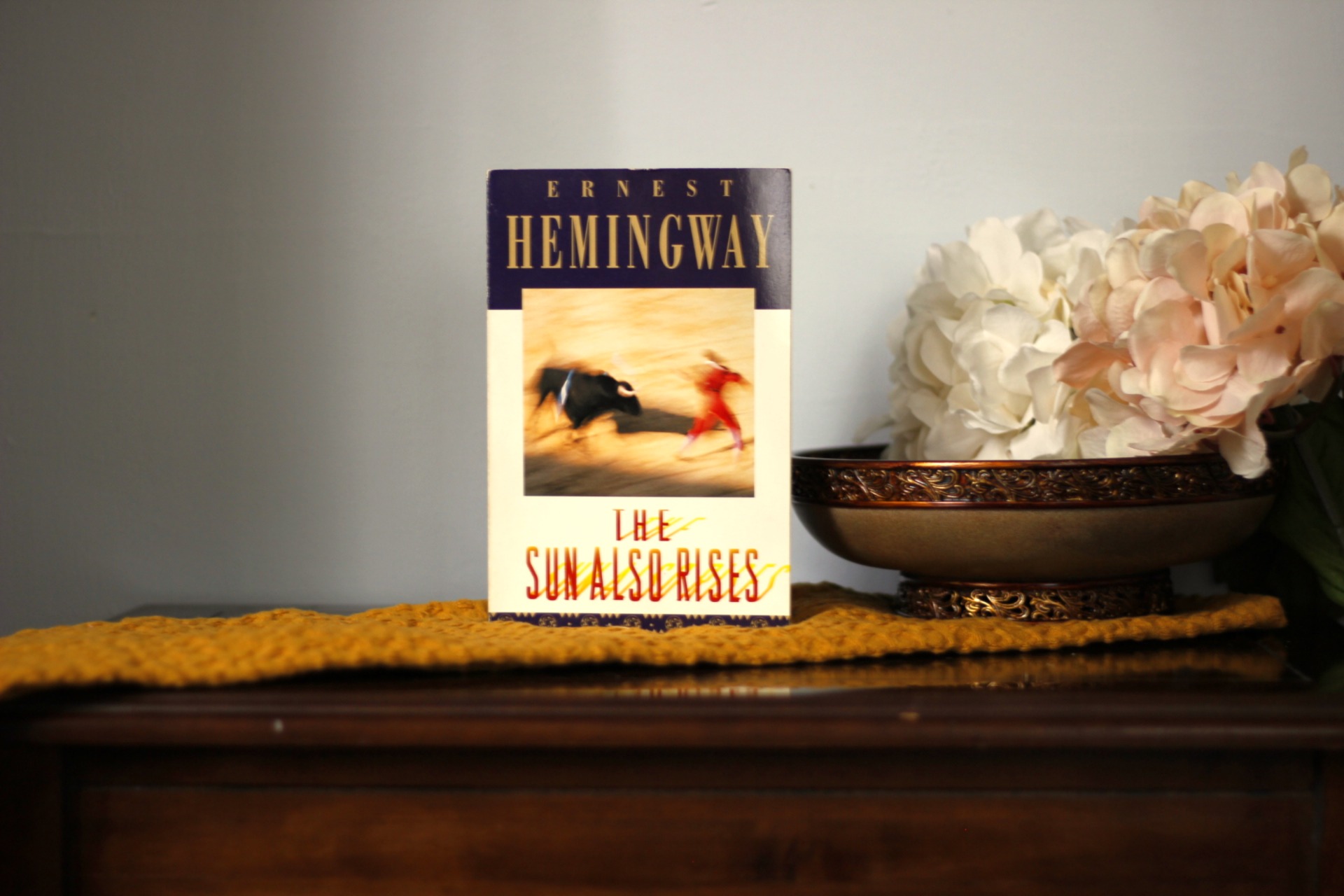
The Sun Also Rises By Ernest Hemingway

This is my first experience with Hemingway, unless I read one of his short stories in college. I have to say, while I’m not enamored, I felt something about this book. Hemingway is either non-descriptive, or too specifically descriptive. He’s dialogue heavy. His characters are allegedly boring, and yet there’s something of the melancholic hopeful throughout this. It’s very easy, to me, to see Hemingway’s mental state in the pages.

From page 42: It is awfully easy to be hard-boiled about everything in the daytime, but at night it is another thing.

From page 152: Enjoying living was learning to get your money’s worth and knowing when you had it. You could get your money’s worth. The world was a good place to buy in…. Perhaps it wasn’t true, though. Perhaps as you went along, you did learn something. I did not care what it was all about. All I wanted was to know how to live in it.

There are several small moments like that through the whole book. Snippets of a glimpse into someone trying to live the life he thinks he’s supposed to, but not seeing the point of much of it.

I’ve noticed with the classic authors, male in particular, they have a peculiar way of approaching love in their stories. Hemingway’s character Brett (Lady Brett Ashley) is known for her “flighty” ways between men of the story. She has had affairs with just about all of the main circle. He never explicitly says this is a problem, but for the time this book was written, I’m not sure if he was trying to make her out to be as lost as the rest of them, or if he was trying to make a comment on women in general.

Brett is quick to fall in love, and there’s a part of me that wonders if maybe that’s more her way of trying to find a connection that makes her feel “right.” She’s very much a flash in the pan type character, where her whimsy takes flight about as frequently as it lands, and I think she’s a strong character in many ways.

This is the kind of book that I’d write a whole paper over. Not just a review. There are several layers to it, where we can go into why Hemingway was so focused on the bull-fights in the second half of the book, and what he was going for with the descriptions of the fiesta. The motivations of characters like Robert Cohn, who is a very weepy man in love with Brett and despondent he can’t be with her. Or Bill, who hides his pain in his humor. Mike, who drinks to excess because he can’t face his fiancee is unfaithful, but tries to put on a good show for the others about it.

And then there’s Jake. The journalist who’s just trying to find his place in the world, as with all the others. It’s a thought provoking book in many ways, and I think it was a good Hemingway to read. There are several of his technical elements that made me pause, especially where it seems he has descriptions that appear redundant, but maybe that was the way in his time.

Overall, I would say this was a good book to start my Book Bingo Board with, and I give this 7/10 stars.

Until next time, friends.

Writing Journal #15

Another short update this week.

I’ve released Daisy into the wild. It’s listed on my publications page if you wanna see the final cover and stuff. I’m very much a minimalist when it comes to cover design, and this one is definitely minimal. There’s no summary on the back, and the front is just a flower and the words “a novel” centered on it. The title and my name are on the spine, so it’s not like… a complete mystery. But yeah. Daisy is done.

My November Writing Thing is currently at …. some number of words. I’m 293 away from my goal for this week. I’m contemplating letting myself miss goal since I was working on getting Daisy finished up. I can make it up easily, too. I’m a little less than halfway through to my final word count goal, and I don’t know where I’m trying to go with it entirely. But that’s the beauty of storytelling. It gets figured out along the way.

I’ve decided after I finish writing this piece (currently titled Simon Says), I’m going to gently encourage myself to take a break from writing. I don’t know how well that will go because I must always be giving the world words, but as I’ve finished up my Daisy work, I’ve come to realize I devote a lot of physical energy to a book and I don’t really ever tell myself to slow down.

I have a folder of short story ideas that I’m looking forward to getting into for next year, and then of course there’s the third book of the Maker series, Lazarus Rising. That’s going to be a fun time. I mean that. I kind of went through the first draft a bit, about halfway through for some random edits, and I genuinely enjoy being in that story. It’s a home I created for myself, I think. If I could live in Lazarus, my goodness. It’s one of those situations I wish I could link up my brain to a visualizer and show you what it looks like in each of the cities so you could see it the way I do.

But therein lies the other joy of storytelling. I get to show you with my words.

I had something else to talk about, but I’m currently working on typing something up for a friend, and my wrists are a little sore–OH! Instead of writing the rest of the year, I’m going to be reading. I have two books I want to finish before the end of the year, and then whatever else I happen to come across on my shelves will be a delight. I don’t remember what my current total read is for the moment, but I’ll do a “books of the year” post either at the end of December or the beginning of January.

So, this isn’t a short update, but I got a little sentimental, I suppose. I was thinking about how I made a promise to myself to utilize this website more and I think I’ve done so. It’s been nice to put my thoughts somewhere I know someone might see them. I appreciate the readers I have, and I appreciate the consistency in which y’all see the innards of me noggin.

And with that, I sign off for now. It’s not the end of the posts for this year, but it might be the end of the posts for November. We’ll find out! I hope you’re well. I hope your words taste good, and I hope you remember it’s never too late to tell a story.

Until next time, friends.

Writing Journal #12

Mornin’, folks.

I’ve been, as I told a friend, almost neurotic in trying to get this book done. I finished marking up the manuscript a… day ago, and I’m already on chapter eleven (this morning) with going through to fix things. If all writing were this fast, I would get more done, I think. I did spend about an hour and a half last night before bed reading through Lazarus Rising.

That one I’m pumped to get back into. I forgot how dastardly Mr. Fogg is, and as I was reading through his sections, I kind of forgot I wrote him and just “man, this guy.” So that was fun.

I’m possibly going to have my summer project, aka Daisy, ready by the end of the month, and I wasn’t going to do a big release of it, but I think I might just announce the completion and be all “hey, here it is.” I’m only going to do a print version of it, I think.

I wrote out a list of the front matter I need for this one (the bits in front of the book, for those who don’t know the lingo I didn’t know until I finished Fulcrum), and I definitely think I’ll put a content warning in. It’s not smut on the romantasy level, but there are some descriptive moments. It’s one of those things where I kind of … It’s necessary for character development in this case, like, very necessary, which is the only reason it’s been put in. And the descriptions are there for the characters and how they’re feeling/experiencing things. I hope I did it well. I am going to take one scene out because it is gratuitous, and I think that’s very editorial of me, haha.

I’ve had Daisy in my head since high school, and I never really thought I’d finish it because it just kind of sat for a few decades. It’s got many, many iterations. I’m pretty sure this final content version is in the teens in terms of drafts for it. But that’s the beauty of being a writer. You grow and life experiences color and graft onto your writing style. What I knew in high school is useful, but I’m able to parse through the stuff in my brain far better. Well, maybe. That’s a different story for a different page.

At the end of the day, I’m proud of this book and the story within it, even if I felt like it was an undertaking now in my thirties versus my late teens, early twenties. Maybe my thoughts about love are a bit different, too. Actually, no maybe about that one. I joked around with some friends that I hate love, and then said I don’t, and one of them said back “don’t lie to my face.” I don’t hate it, I just don’t think it fits me right now. I love it for other people, though. Which I think is why this project has kind of been a lot for me to work on.

Good news for me, though, because once I finish this, I’ll never write a designated romance novel again in my life, haha. I will leave that to the professionals, and if there’s romance in my other stories, it won’t be the focus. It’ll be a side quest.

That’s all the shoes on this rack, kids. I hope you have a lovely weekend and I hope the fall air is crisp in ya lungs as you go about your day.

Until next time, friends.

Writing Journal #6

Singing Justin Bieber’s “Baby” while unwrapping a peanut butter cup is peak Saturday morning behavior, I think. I don’t know if this is journal number six. I could look, but that requires more dedication to a numbering system than I particularly care for currently. I don’t know “Baby” past the chorus, so it’s been just a repeat of “baby, baby, baby, ohhhhh” progressively more offkey.

I haven’t been stuck. Well, no, I have been. Stuck in chapter twenty of the Lazarus Rising first draft. I’ve come across things I’ll “fix in post,” I tell myself. Scribbling late into the night because insomnia has come to visit again. Who needs sleep when words give so much more to me? I probably do need sleep, because the headaches that have come from this lack of it are just debilitating sometimes.

But yeah, finally got through chapter twenty, and I actually made it through chapter twenty-one. Finished that last night, and then when I woke up this morning, I had some clarity to restart the gibberish I wrote to open chapter twenty-two before I passed out.

Currently, peanut butter cups are eaten, and water should be next to consume, but that requires getting up again and I just sat down to keep typing up chapter fourteen. I don’t want to get half a book behind on typing again, so I’m going to spend today doing some of that. After I have brunch/lunch with some friends.

Depression has been keeping me company as of late. I see it. I wave at it when I get home. I tell it how my day has been, knowing full well it’s been right there at my ankles the whole time. It knows my weaknesses. It knows my sadness. Not a bad roommate, really. More like a mother giving you the silent treatment and you aren’t sure what you’ve done wrong, so you’ll keep trying your best not to mess anything else up.

I hope you’re doing okay. I hope you’re able to see the sun, and I hope the warmth sticks with you longer than you expect it to.

Until next time, friends.

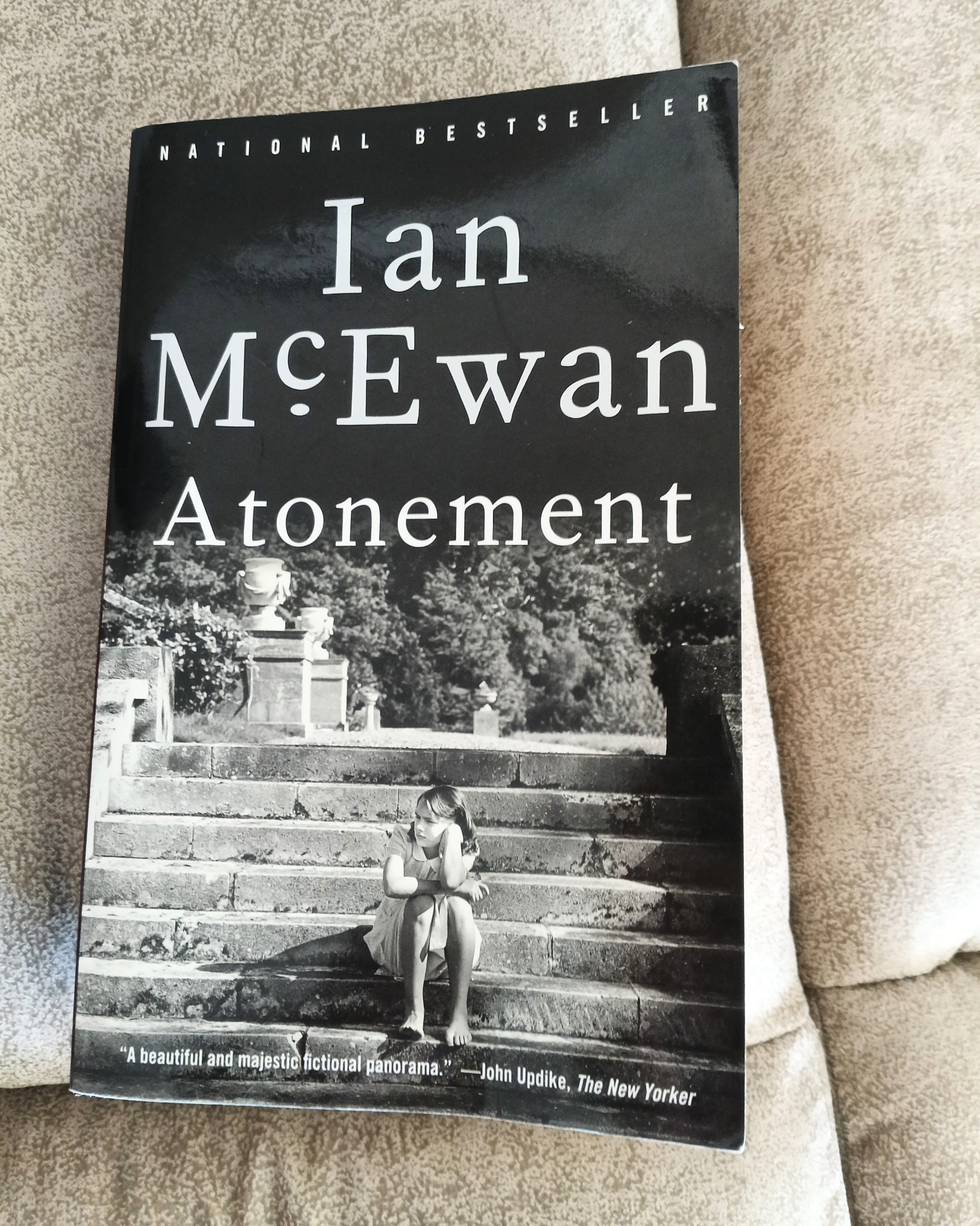
Atonement by Ian McEwan

“It wasn’t only wickedness and scheming that made people unhappy, it was confusion and misunderstanding; above all, it was the failure to grasp the simple truth that other people are as real as you.”

I had this book sitting on my “I’ve read this” shelf and recently went looking for something else when I spotted it. It sat on my “I haven’t read this” shelf for a while because I knew the story already. I’m a big, big fan of the film adaptation of this book, and from the synopsis, it followed the story pretty accurately.

I was not prepared for how deeply beautiful this book is. In the beginning, it’s told from the perspective of a thirteen-year-old girl who misunderstands something she sees out a window. A few more things happen within the space of an afternoon and evening, and as a result of her incorrect assumptions, lives are shifted into irreversible directions.

The film follows the book nearly scene for scene, which I felt incredibly kind of Hollywood. The story is rather important in all its moving parts, as most are, but with something so delicately perched on the bevel of catastrophe, anything left out would render the whole thing meaningless.

In reading some of the reviews, there were several people bothered by the fact the main character, Briony, doesn’t seem to “grow up” over the course of the book. This mainly stems from how she interrupts the rape of her cousin, and because of her false accusations sends an innocent family friend to prison.

The book stays mainly in Briony’s perspective, so we see her grow into a young adult at the precipice of a country at war. She doesn’t take her place at Cambridge, and goes into nursing–like the sister who fled the family on the arrest of the family friend. Briony comments on knowing she was wrong in her youth, and several of the reviewers were upset the rape isn’t discussed past a certain point.

My response to that is why would Briony talk about something that didn’t happen to her? I don’t mean that to sound callous, but as someone who’s experienced sexual violence, I don’t really find it pleasant to discuss. I don’t think the few people who know the situation sit around and talk about it amongst themselves either, so placing a responsibility on the main character to go into such an experience feels a little beside the point. She does eventually attend her cousin’s wedding, and it’s revealed her cousin marries the man who raped her (very much not the family friend). That and a few things Briony says at the end of the book are the only time it’s really mentioned again.

I don’t find it her responsibility to process such an event. McEwan could have written Lola’s perspective into the book, but she wasn’t a main character, and so having her show up to think/talk about her experience would have disjointed the story entirely.

The other thing people commented on was how the whole situation wasn’t important enough for a book. To that, I say, they missed the point. No one wants to read about a wealthy family crumbling because of misplaced accusations and a war. Not truly. But the depth of perspective we get from Briony shows us how penance cannot be achieved perfectly. By the end of the book, she is an old woman and discussing her regrets, so to speak, and what I love so much about it is the vast scope of her understanding, and the pain she has at not having her sister in her life.

I know my opinions are not the right ones. But they are mine, and I see Briony as faulted, someone who caused tragedy and bore the weight of that tragedy the rest of her life. Some would say rightfully so, but I feel like those people forget what it was to be thirteen and not understand the world the way we see it as an adult. We know right from wrong, but if we don’t know the reason or the why for something, it’s hard to articulate the responsibility.

9/10 stars

*******I read the First Anchor Books 2003 paperback edition*******

Writing Journal #3

I’ve finished chapter eight of Lazarus Rising’s first draft. I’m writing from Fogg’s perspective in the beginning of this book, giving him some space to be seen. Not that he deserves such a grace given who he is. Some of the feedback I’ve gotten on Keeper is how dark it is, how violent Frankie ends up being in some instances. I guess I never really saw it as violence if she’s just using what she learns in defense of herself. Because that’s what it all ends up being, self-defense. I suppose I could probably leave some of the finer details out, but what I’ve enjoyed about my writing growth while working on the whole Maker series is seeing how I can use the darker sides of myself to propel a story. How I can give voice to the parts of me that otherwise wouldn’t be expressed. I’m not a murderous psychopath. But someone in my stories is, so I can take them as far as I want to, knowing I am safe from their evilness.

That then begs the question: how much of it is author-insertion? Do I have thoughts of violence? Do I run through the scenes that appear in my books like I want them to be realities? I don’t want them to be real. That’s the beauty of living in fiction, I can put people who don’t exist through extraordinary ordeals to show just how much they can handle–or not handle–and come out on the other side of it. It’s a wonderful thing, the power of creation. I don’t want the world to burn in reality, but I can sure write it doing that very thing in a book.

I’m going to keep going for tonight, and get as much done in chapter nine as I can. I’m almost done writing Fogg’s bit, and then I’ll have a chapter interlude for the Unbound, and then it’s back to Frankie. The page number formatting for this is going to be a nightmare, but I will get it done.

And that’s all I have for you today. Until next time, friends.

Books of 2024

I figured why not start with a bang and go into the books I either liked the most or had a lot of thoughts about in 2024. My grand total of books read was 93. I did not, in fact, finish reading The Fires of Heaven by Robert Jordan like I promised my brother I would, but we’ll get into that later. The books I’ve chosen for this list are the ones that stuck with me throughout the whole year. Most of these I read months ago, and some I finished far earlier in the year, and they still stick with me.

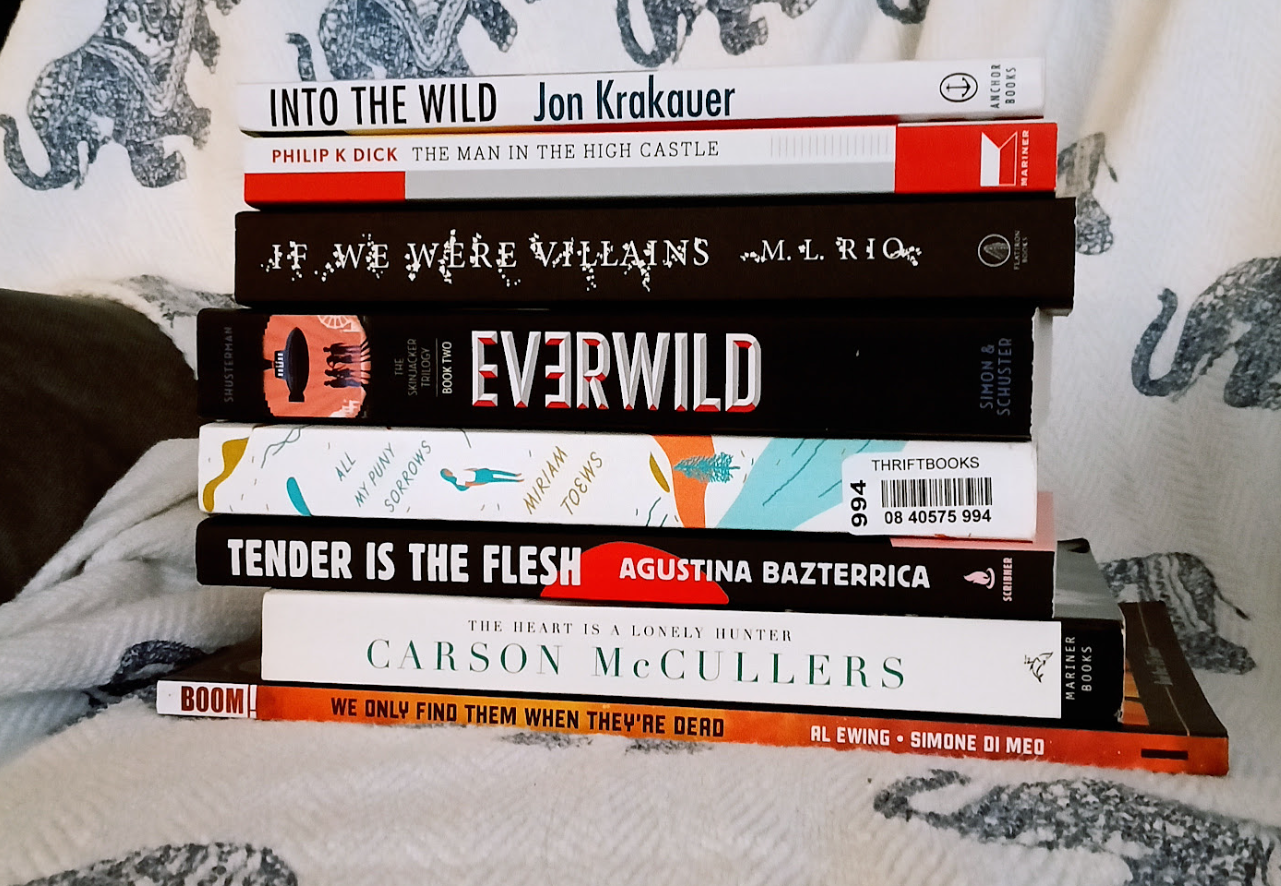
1. Tender is the Flesh by Agustina Bazterrica
I feel like I need to say that if you are not the kind of person who reads heavy topics, this is not the book for you. A lot of the reviews I read of this said that it was disgusting and horrific and I feel like they missed the point of it. This book is not one to enjoy, necessarily. It’s one to make you think way too deeply about the state of humanity. It is a plunge into how people treat others, and that is such a superficial approach to it. It’s societally accepted cannibalism. There are humans bred specifically to become meat for other humans to consume. There are laws in place to “protect” the meat, and there are other things surrounding the “rights” of the ones being used to feed the masses. It’s told from the perspective of a production plant manager (I don’t remember his title officially) who’s dealing with his father going through Alzheimer’s, and a host of other issues both personal and professional. I will say that by the end of this book, I felt like I’d participated, and if you’ve read it, you know what I’m saying because the ending just left me bereft for a few days. I immediately recommended it to some of my friends. It is a purposeful calling out of people who mistreat others and also a scathing commentary on how society is structured. I gave this book 9/10 stars.

2. The Man in the High Castle by Philip K Dick
This book is on the list because it disappointed me and I’m still thinking about the ways it did and how it could have been better. I’ve not read any of Dick’s work before, so this was my introduction, and I was left wanting. He presented this incredible “what-if” scenario and then left it to the imagination for most of the events happening. So much of it occurred “off-screen” and I found that incredibly lackluster for such a stunning approach to alternate history. Especially since it’s for WWII, which has been a topic of debate ever since people realized they could theorize about the “what-ifs” of history. I started reading it because I watched the first episode of the show of the same name, and this is one of the few times I’ve uttered “the visual media is better than the book.” It gives substance to the ideas Dick presents in his book. It shows us the battles, the intrigue that’s hinted at within the subtleties of the writing. I’m glad I read it so I could see what it was, and I’m glad I watched the show (haven’t finished that yet) to expand on what the book could have been. I gave this 5/10 stars.

3. Everwild by Neal Shusterman
The second book of the Skinjacker trilogy by Shusterman made this list because it was the one that stuck with me the most. I think one of my favorite things about Shusterman’s storytelling is he invents new ways to approach death, which is such a difficult topic for anyone to discuss, but especially young adults. I do think sometimes the romances are a little unfinished and rushed into, but if that’s the only critique I have of his writing, I’d say that’s all right. I don’t know if it’s my appreciation for his writing that makes his books appear on my “that’s my favorite” lists, but there is something about his approach to illuminating the dark places of sadness that keeps me personally afloat when I could very easily sink. The trilogy as a whole is a stunning tale of lost children, and some of the ways they “go into the beyond” left me nearly weeping. This story is one I will think on, much like I think about his Arc of the Scythe series. I gave this book an 8/10 stars.

4. Into the Wild by Jon Krakauer
Ohhhh, this one broke my heart. This is the journalistic telling of Christopher Johnson McCandless, the young man who went into the Alaskan wilderness with nothing but a ten-pound bag of rice and serious hopes and dreams, and ended up losing his life due to some unconfirmed circumstances. He wasn’t murdered, but there is speculation he ate some poisonous seeds while he was already weak from malnutrition and he couldn’t survive. Krakauer retraces Christopher’s journey to this epic adventure, and he meets the people who were impacted while the young man was finding his way to his eventual demise. Several people called him an idiot, saying he had no business being in the wilderness with so little experience, some called him noble for following the passions of his heart, and his parents and family missed him terribly. Christopher burned bridges he didn’t need to, for reasons only he knew, and I think the hardest part of this story was seeing how his determination to do what he saw as necessary only alienated him from people who genuinely cared about him. It wasn’t so much the societal obligation of family, his parents legitimately worried about him and his sister lost one of the people she was closest to for a myriad of unknowns. Some people criticized Krakauer for glamorizing this tale, and I can see where they’re coming from, but for me this wasn’t a glamorization. It was a caution to be passionate, but be intelligent in passions that can kill you. Even the most experienced of wilderness dwellers can run into situations of extreme danger, and they will need to rely on their in-depth knowledge to survive. I admire Christopher’s drive to be who he was. I just wish the world had gotten more of it. I gave this book 9/10 stars.

5. If We Were Villains by M. L. Rio
If you don’t like Shakespeare, this is not the book for you. The characters quote it pretty much every page and it is a serious, dark tragedy being uncovered throughout the course of the story. It’s told in flashbacks, with present day scatterings throughout, and that format works well for this. A group of theater students at an exclusive college for the arts forms a tight bond. Their friendly rivalries become dangerous, however, in the last year. The opening night of their final performance, something horrible happens, and one of them is killed. Was it an accident? Self-defense? Malicious? Even flipping through it now to write this post, my throat is closing up on tears trying to escape for the sadness inside this book. One of my quotes for the year comes from within the pages, said by a character toward the end: “Nothing is so exhausting as anguish.” I loved these characters, and I was broken hearted by the time I finished this book. It was beautiful and I gave it 9/10 stars.

6. We Only Find Them When They’re Dead: Book One, the Seeker by Al Ewing and Simone Di Meo
I love science fiction. Once I discovered how vast a genre it is, my entire world opened up. Reading, yes, but also writing-wise. It encompasses the biggest part of being human: curiosity. There is curiosity in most genres, but in science-fiction, there are literally no limits. You can go into space, you can dive to the deepest pits of the ocean, and you can give it all a name that only makes sense to you. What I don’t love about science-fiction is how people tend to send their characters into space and then have them get spicy on a spaceship. There are several other things I dislike about modern science-fiction, but that is for an entirely different blog post. What this book did for me was give me the delight of curiosity I’ve hungered for. Humanity’s only food source is the bodies of dead gods that appear throughout the universe. One captain decides to find out where the gods are before they appear. This trilogy of graphic novels is stunning, both in art and storytelling. The characters are diverse and multi-faceted. They bring humanity into space and do something with that instead of arguing solely about politics and who owns what. There is some political arguing, but that’s simply the nature of the genre. I loved this series, and this part of it was incredibly magical for me when I first read it. I gave it 10/10 stars.

7. All My Puny Sorrows by Miriam Toews
Have you ever put a book on your list to read only to let it fester because you know it’s going to take a lot of your energy to read it and you don’t want to give those emotions much space just yet? That was this book for a few years. It’s been on my to-be-read shelf for at least three years, and I finally decided to read it. It’s about two sisters, one a concert pianist with a determination to die, and the other a single mother trying to keep everyone around her alive. The book hits on themes and thoughts I personally have had, both sides of the disease of depression, and I think I knew reading this one would be hard for me. It’s freeing to see your own thoughts on the page written by someone else, but it’s also incredibly exposing and leaves one feeling vulnerable to everything horrible. I read this book hoping it wouldn’t end the way I expected it to. I won’t say whether it did or not, because I don’t want to spoil it, but I will say it is worth the difficulty of being seen. I gave this book 9/10 stars.

8. The Heart is a Lonely Hunter by Carson McCullers
Even typing the title, I’m trying not to cry. The moment I finished this book, I wanted to ask Henry if he’d read it. McCullers published this when she was 23-years-old and I have never read anything by anyone that young who understood what it is to be human so clearly and purely. I initially wanted to read this book based on a quote I read probably a decade ago, “the way I need you is a loneliness I cannot bear.” I have it on an index card hanging on my wall right now, and it’s been on every wall in every place I’ve lived since I found the quote. It’s haunted me, and now that I have the context for it, I am not entirely shattered from it, but I am a different person in some ways. This is, without hesitation, one of the best books I’ve ever read in my life. It is about surviving life alone, surrounded by so many people. It’s about being a kid without understanding why the adults are so serious, until one day you do. It’s about wanting to be heard, but no one can fully know the depths of your knowledge because they don’t have the experience you do. It’s about trying to do right by children who grew away from everything you taught them. It’s about love, the purest kind, and it’s about longing. To be held, to be seen, to be. This book is a gift, and I will love it always. 10/10 stars.

And that is the list I have. This is a long post, and I probably could have broken it into parts, but that’s not how I feel like living life today. I have reading intentions for the year ahead. I wanted to read 5 non-fiction books this last year, and I did. I want to continue that and make it a tradition this new year. I want to finish The Fires of Heaven because I do want to read the whole Wheel of Time series, but this one is the least compelling of the ones I’ve read so far. Rand is so annoying. I’ll probably post some book reviews this coming year, and I will absolutely be returning to the blog more frequently.

If you made it this far, I hope you are doing well. If you are not, I hope you are able to find some peace, inner or external, either one I wish upon you. You were not born to this world to suffer. Thank you for being here, and thank you for taking time to read this list of books that made my 2024 a solid year.

Until next time, friends.

If the Trees

Note: This is a short piece I wrote for a contest last month. It does contain strong language and drug references (marijuana).

Malcolm saw the caravan first. I know he debated even radioing the rest of us, but he probably figured I’d make his life more miserable if he didn’t. The caravan was parked where Solomon said he’d leave it when he told us last night. I rode up on my motorbike and sat staring at it for a few minutes. Waiting for the others. Wondering why I didn’t just go in and get it over with.

I heard Malcolm’s ugly voice calling out from behind the silver bullet of a trailer. He hollered about how the door was locked. His irritated banging had me off my bike and running across the abandoned lot before I knew what I was doing. His gray caterpillars for eyebrows shot to what was left of his hairline as I skidded around the bumper.

“Oh, didn’t know you heard the call out, Sida.” He bowed and backed away. “Ladies first.”

I shoved him away, my blood boiling. “Hoping I didn’t want to see?”

“Can you even get in?” He hitched his sweatpants higher and retied the drawstring. “Bastard locked it before he went all vagabond-y.”

“Will you shut up?” I rubbed my forehead, my eyes squeezed tight. Headache percolating behind them. “Go wait for the others.”

Malcolm scrubbed his hand over his two week stubbly beard. “You aren’t the only one who’ll miss him.”

I gave him a small grimace meant to be a smile as I dug into the pocket of my jeans. “You just hope he left behind his weed. Please, Mal? Let me have a moment.”

He waved and grunted as he returned to where he’d parked his truck. I pressed my palm to the door, the metal cool even though the sun had been out that day. The first time I went into the caravan was the day Solomon joined the crew. He met us at a rest stop out in Ohio and had no kind words when Malcolm assigned me to be his navigator. He’d tolerated me and let me know it. Guys like Solomon didn’t need to be told where to go. They went and the world followed.

I unclenched my fist and slid the key into the lock. He gave it to me three years ago. We’d stopped at one of the campgrounds for a week, watching everyone else at another crew’s fire. Solomon hated the noise, and I did too, but never said so.

He had a softer voice than people expected. His gruff exterior always scared kids and made their parents raise their eyebrows. Old enough to be my father, and I still looked about forty years younger than him. We sat at our caravan—his caravan—listening to the laughter take over our friends. My friends.

“Two years, yeah? That’s how long you been my navigator?”

I dragged my eyes away from Malcolm flirting with the matriarch of the other group. “Yeah, two years.”

He rubbed his chin and nodded, not looking at me. “You like it, Sida?”

Something about how he said my name made the rest of the world go quiet. I nodded, unable to take my eyes off of him. “I love it.”

That was the end of the conversation, but before I headed to my tent, he pressed a key to my palm and told me to hold on to it. The same key I now had waiting to turn. I didn’t want to see inside. Not without him. It wouldn’t be right.

Gritting my teeth, I swung open the door and let it close quietly behind me. I hated it immediately. The caravan smelled like his cigarillos. I laughed and sank against the counter of the kitchenette.

“Damn it, Solomon,” I said, lightly tapping my forehead on the cabinet above the practically useless sink. I’d broken the faucet once trying to make him dinner. He fixed it, but it never worked right in the winter.

“Focus.” I didn’t have long before Malcolm would figure out I had the key.

I knew where to find what I needed to. Solomon told me two nights ago. He’d asked me to stay the night. I should have known. He never let me stay. Said it would ruin my reputation, even though they already thought we were together. Said he didn’t want the others to talk about me like they knew me. They did know me, I protested, and he told me the only knew a speck of who I was. It made me laugh and I lit one of his cigarillos for him.

“And you know me so much better, is that it?” I propped my feet on the dashboard. “My own momma ain’t know me, man. What makes you think you do?”

He didn’t answer, just took a long drag. “I got money. Not much, but enough. The others don’t know about it. In case something happens, I want you to have it.”

“You planning on me needing it?”

“It’s just in case,” he said, snapping a little. He rubbed his bald head and sighed. “I want you to stay tonight, Sida.”

The sound of tires on gravel ripped me back. I cleared my throat and went to the front. The passenger seat. Where I usually planted myself for hours at a time. We didn’t talk much at all those first few months. He’d mostly argue with me on directions and be mad when I was right.

I swiped at my eyes and opened the glove box. “You absolute bastard,” I muttered as I pulled out a small box.

It wasn’t very wide, but it was long and deep. Everyone else knew this box as his stash. His weed sat in neat bags balled up in the far corner. There were food vouchers in a bundle held together by a rubber band.

A folded piece of notebook paper waited on top of it all. I sighed, more of a groan, and opened it. “Fucking asshole.”

Sida, this won’t be long. I said what I needed to already. I hope you’ll indulge in the weed at least once, but if not I’m sure Malcolm will take care of it. You know how to find the rest. Take any books you want. Burn the rest of it down. –Solomon

I laughed and got up, still holding the box. Standing took too much effort and I sank down against the cupboards and hugged my knees as sobs took over. As quietly as I could, I cried for Solomon. Something he’d have hated.

Two nights ago he asked me to stay. Every other night, we’d separate to sleep. I’d head to my tent, wishing I could slip under his sheets and lay beside him. Just be next to him. He brought me into the caravan long after everyone else had gone to sleep. I didn’t know what to expect, really. But he held me. That was it. He held me as we talked even more. It was all I’d ever wanted, and being close to him, pressing my face into his shirt, feeling his chest rumble as he spoke in the too early hours of the morning—I’d never known anything like it.

He’d despised me for so long, hating that I was beside him everywhere. It was the rule of the crew, though, that everyone went in pairs and there was a navigator. Eventually after several long months, he didn’t tell me to shut up and we talked. About books. Stories he wanted to tell but never had the right person around to hear them. He’d been divorced since the nineties. After his only novel sold, he quit the life he knew and began his roadtrip, a circuit around the country, weaving through the states on his way from coast to coast. He found us through a bulletin board posting at a rest stop near Chesapeake. Met us in Ohio. He liked Malcolm. At first.

I pushed myself up and began to dump out the box. On the bottom was a tiny button. Pressing it opened the lower half. Ten thousand dollars. I stuffed the cash into my jacket pockets and laid everything else on the counter.

Two nights ago. Solomon took me to his bed and ruined anyone else’s chances of me falling in love with them. He stroked my hair, listening to the night sounds around us, the dimness giving him eerie shadows on his face.

“I’m leaving the group,” he said into my hair.

“Why?” I tried to sit, but he held me still. “Solomon, I don’t–”

He rolled onto his back and put his hands behind his head. “It’s time. I’m going to hike for a while. Live off the land. Become the land.”

“But won’t you—won’t you be lonely?”

His smile surprised me. He reached over and trailed his fingertips along my arm. “I don’t think so.”

A lump almost choked me and I faced away from him. The bliss turned to ash in my gut and I wanted to leave. He rose to his elbow and pulled me back. Cupped my face so he could study me. Learn every bit of my face and burn it into his brain forever.

“I love you, unearthly thing. That’s why I won’t be lonely.” The kiss he gave me felt like goodbye.

Malcolm slammed open the door as I was putting the books I wanted into a small box. “You’ve had quite a few moments. Where is it?”

I passed him the weed and food vouchers. “Here, you prick.”

“Did he off himself?”

I went to the door and took a last deep inhale, patting the pocket I’d tucked one of his cigarillos into. “You should get what you want. I’m burning it.”

“But we can use it, Sida.” He gestured to the rest of the caravan. “Cleaned up a bit, we could do so much with–”

“Five minutes and it’s on fire.”

Leaving him to paw through the contents, I took my box to my bike. The others had arrived. Malcolm’s wife patted my arm as I passed her. She winked and fixed her face into a serious mask, calling the others over.

No one wanted to go in. The crew just stood around waiting for her say-so. Eventually, they’d have to go in. Such was the nature of nomads. Take what’s useful, leave the rest. Magda gave a nod and they descended on the caravan. I turned away, unwilling to watch the desecration. My gaze landed on the box of books. Sniffling a little, I picked up the top one. Solomon insisted it was the best book of all time. I told him it wasn’t as good as some of the others he had in his collection. He didn’t talk to me the rest of that day.

I flipped open the cover and watched a photograph fall out. Crouching, I picked it up, not ready to see what I already knew was there. The moment I’d taken it lived forever in the back of my mind.

A year ago. Even though I never said so, Solomon knew I loved him. I think that’s why he never let me stay with him whenever we stopped. He thought he wasn’t enough for me. I didn’t know how to say he was, so I slept by myself in my tent, popped up next to his caravan.

I’d found an old Polaroid camera at a thrift store. It was only a few bucks, and I traded some of my food vouchers to Magda for use of her debit card to order film. I wasted most of the film. Taking photos of everyone. Solomon refused to be photographed. But as we entered our campground that night, I told him it wasn’t for anyone else, just for me. He’d given me some serious side eye as he stubbed out his cigarillo.

“Fine, but you have to be in it, too.”

I agreed and situated us so we’d both be in frame. Began the countdown.

“Look at me, Sida.”

It was the best picture I’ve ever taken. Both of us were lit by the last golden rays of the setting sun. He had a ghost of a smile while I beamed at him. He’d taken the photo from me and shook it before sticking it to the dashboard. Said it was for the both of us.

As I straightened, I saw he’d written on the back of it.

I hoped you’d take this one. I know I’ve made you mad. Probably think I’m an ass. But the beautiful thing about all of this, the whole last six years of my life, I wasn’t even looking when I found you.

I tucked the photo back into the book and turned to see Magda watching. She tilted her head and came to stand beside me. Passed me her pack of cigarettes and cleared her throat.

“I’ll give them five more minutes, and then I’ll let you light it up.” Her cheek twitched as she saw Malcolm wave from the driver’s seat. “I’m sorry, Sida. You can meet us in Topeka if you want to take some time to find him.”

“It’s fine,” I said as I lit a cigarette. I held the smoke too long, but forced myself to push it out in a long, slow breath. “If the trees are his home, the road is mine.”
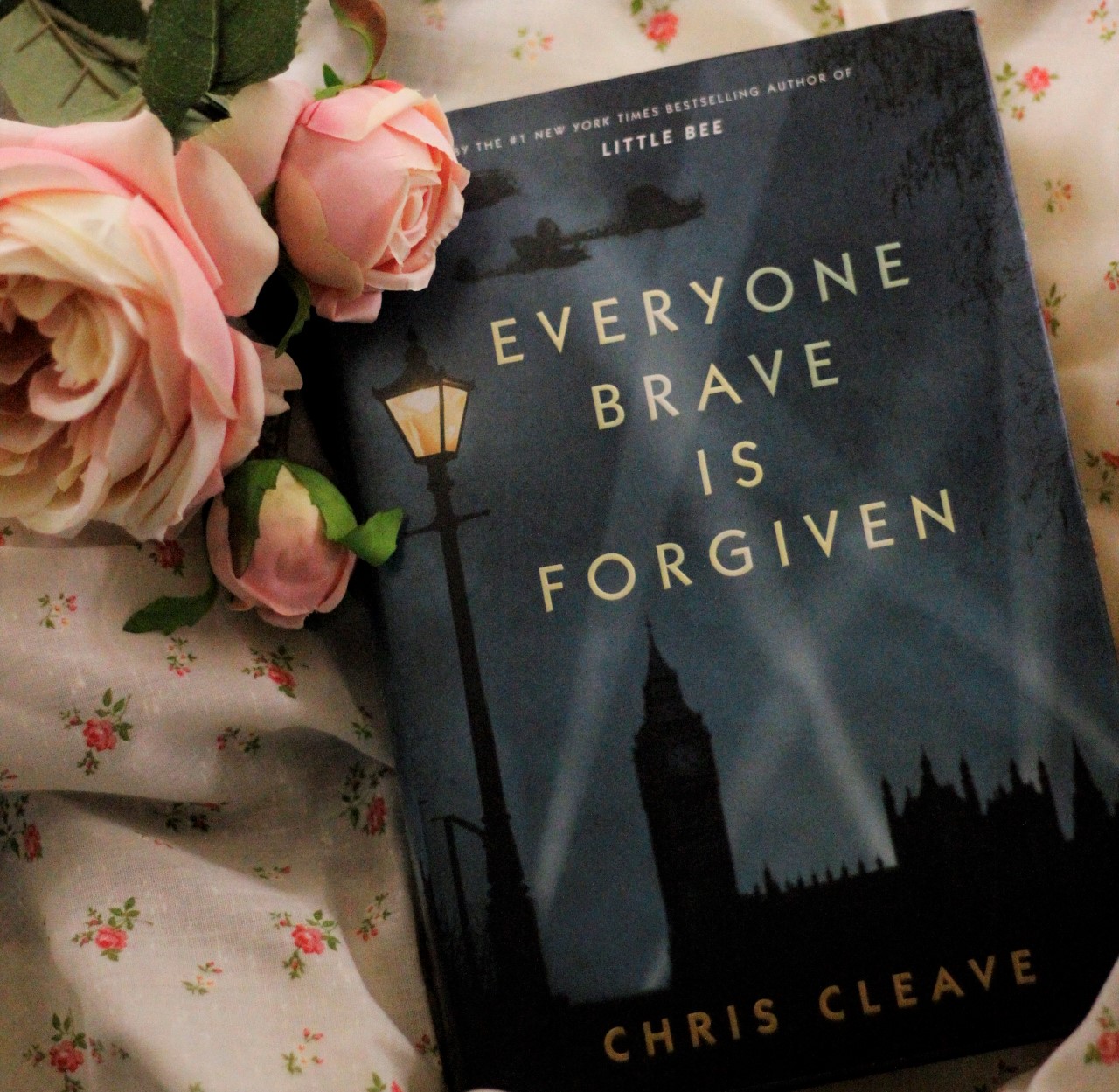
Everyone Brave is Forgiven by Chris Cleave

Everyone Brave is Forgiven grabbed me by the title and I pulled it from the shelf without much other thought. From the cover, it looked like it was going to be about London during WWII, and I was correct, but I still put it on my to-read shelf and forgot about it. I don’t know if I’ve ever said so on here, but WWII is one of my favorite times to read about, fiction or not, and so I tend to gravitate toward those stories. So many of them are similar, and yet all of them are different. I find sometimes they can be a bit predictable, and while at times this book was to me, I still enjoyed what I read.

What I liked about this book the most was the main female character, Mary. She comes from an upper middle class family (fairly more well-to-do than a lot of people), and when mobilization begins, she decides to join up in the form of becoming a spy. Well, they don’t need her to be a spy, but they do send her to a school to be a teacher. She has no experience in this field, but she takes to it easily, loving the children instantly. She becomes a teacher right before the evacuations took place and children were sent to the countryside of England.

Mary befriends a black boy, Zachary, and she promises to write to him while he’s away. Racism is a theme in this book, and while Mary sees nothing wrong with being friends with Zachary (he’s a small child), her family and friends tell her she’s being impertinent and socially incorrect. There’s quite a bit of language used that made me uncomfortable, and I know it’s “how they talked at the time,” but it still gave me some pause as I read it.

Zachary is abused by the people in the country, and eventually he’s brought back to London where he goes back to school with Mary as his teacher. Mary has a unique talent for getting what she wants, and when her class is evacuated, the first thing she does is go to the man in charge of her district and asks for another class. He tells her there isn’t anyone to teach, but she points out those who were left behind for “difficult circumstances.” Sometimes Mary’s privilege shows when she can’t understand why certain things are done the way they are, but by the end of the story, she’s learned. Mary is vibrant, sarcastic, and determined. Her enthusiasm for doing what she believes to be right is never quite squashed by the bombs dropped on her city.

There is heartbreak and absolute tragedy throughout the story. Depictions of violence and some graphic details of war wounds and building devastation. It all adds up to a well told story that by the end of we are possibly just as tired as the characters. The few moments where I was dragged out of the story because of my stretch for belief were few, and hardly significant past the moments they were.

I give this book an 8/10.

*******I read the 2016 Simon and Schuster hardback edition*******

The Girl Who Said Goodbye

This week we’re doing something a bit scary for me. I don’t often share my writing publicly because it’s often something I consider too personal. Good approach if I want to get published one day, huh? Anyway, this is a piece I’ve worked on off and on for a little while. It’s about death and the afterlife, so if that is something you find troublesome, please skip this post. Otherwise, I hope you enjoy it.

A dry hacking sound tore through the house. From under the covers on a crumbling bed, a papery hand reached for the glass on the table, fingers trembling on its smooth, cool surface. Empty. Frederic knew it was, but with everything, he’d forgotten. He coughed again. A fit overtook him and if he could have crawled to the bathroom to spit the blood, he would have. Sunken with age, his chest heaved as he tried to get a full breath of air. The coughing died to a steady wheeze with each shallow pass.

Something clattered on the stairs. Fear froze his stomach. He cried out, a pathetic, weak sound, and covered his face.

Someone burst into the room, shattering the warped wood of the frame. A woman with matted and tangled black hair staggered in. Paler than a sun bleached mouse skull. Her coat, an army green thing, shredded to her elbows with strips of mangy fabric dangling as she searched the room. She dug into the pocket of her khaki colored trousers, a small notebook in her hand. She flipped through it as she studied the room, nodding to herself. Her eyes landed on the lump on the bed.

At first, Frederic thought she was there to rob him. She certainly looked the part. No shoes. Tear stains left salt crusted trails down her cheeks through the dried muck smeared on her skin. He watched her as closely as his tired eyes would let him. A quiet beep made her check her wrist. She looked at him, her eyes suddenly clear, a bright green piercing him with kindness. She smiled and the fear left him.

“Will you open the curtains?” Frederic gestured to the window. His voice cracked like dry leaves on a sidewalk. “The curtains.”

She shook her head. When she spoke in English, his shoulders seemed to sink into the mattress further. Her eyes closed and she tipped her head back, as though trying to remember.

“Je suis desole,” she said, her accent marring the fluidity of his language.

He nodded and pointed, the weight of his arm almost crushing his chest. “Please.”

She went to the window and waved at the heavy fabric. “Oui?”

He nodded once more. She pulled one side over, and then the other. A sigh deflated him.

“It has been three days since I’ve seen them, the stars.” He tucked his hand under his cheek and smiled, his watery blue eyes bright. Tears slipped over his nose, but he didn’t bother to wipe them. “I have not seen–“

She sat on the bed by his knees as he wept what was left of his tears. The sound of his dying filled the silence. No death rattle, simply weary breathing. The woman remained on the edge of the bed for a while after he inhaled one last time.

She wasn’t ready for the next part. She never was. With a shuddering sigh, she shook herself from her head to her toes and cracked her knuckles. The soul was in there, waiting. She could feel it radiating from just below his ribs. Not quite the stomach, but just above it.

“Let’s get you home,” she whispered and stroked his cheek.

Her body trembled as she looked into the ceiling, her eyes going completely white. Offering a quick word of what could have been a prayer, her form shifted into an ethereal translucence, making her look almost dead herself. She plunged her fist into his chest. If she’d been solid, she’d have snapped his ribs. But she didn’t need a body for this.

One more deep breath and a hard yank. She held his soul, its tendrils spilling over the palm of her hand, trying to fill the body below once more. She gently folded it together and eased it into her satchel. She touched his forehead, a sad smile on her cheeks. His eyes remained open. He’d been without the stars long enough.


The woman, Gabriel, clambered down the stairs, her form solid again. She made sure to leave the door open, something she always did for those like Frederic. Pausing, she looked back up at the bedroom window. She blew him a kiss as she backed out of the front gate, past the delphinium and hyacinths, the tall wild grass choking the fence. She sent one more kiss his way, and waited, her hand at her throat, as though she could stop the weeping behind her teeth. She wiped her nose on her dirty sleeve and stepped off the curb in front of the bus speeding toward the city.

It caught her as it always did and she swung herself up onto the roof. Flattening against the cold metal, she let herself become translucent once more, part of the heat emanating from the warm bus inside. A shimmer passing by. She held her satchel closer, remembering the man she held. Hoping they’d find him soon.

Fifteen minutes later, she let herself slip from the rooftop and land on her feet beside a bus stop. She plopped herself down on the bench and sighed as she rubbed her eyes. Getting back to the underworld wasn’t the difficult part, but she always hated the sensation of leaving behind part of herself every time. A few deep breaths later, she clenched her fists and gave over to the pull all souls feel from the beyond.

It dropped her at the entrance, similar to the way grand hotels looked from the inside, the afterlife’s way of giving the departed a peaceful sendoff. She pushed open the door and stepped onto the street. The hazy gray light bounced off of empty, dilapidated buildings. Her feet knew the way, and she let herself get lost in her thoughts as she made her way to her final destination.

She loved them, those creatures she carried. They represented the good of the world she’d left behind all those years ago. Her task to give the souls their last bit of love before they rejoined the stars in the underworld sky made it less challenging. Often she’d be whisked from place to place, though. Too many died alone, and she couldn’t let that happen.

But she found them. All the same. She found them at each and every bedside, each broken bridge, the crumbled stairs in buildings long abandoned. They wandered without someone to hold them in, those souls, never straying too far, however, from their bodies. Just in case.

Gabriel knew she had the job no one else wanted. It was most difficult on a day with suicides, car accidents, and stillborns. But she treasured those souls a little more. Carried them in special paper she’d designed from the sea kelp to keep them from getting crushed by the others in her bag. Some of the gatherers didn’t like souls. Found them too alien. Smoke monsters, she’d heard them called. But there was nothing monstrous about them.

They all mattered. Every single one of them. Who else would show them a final act of kindness before they left? Certainly, she was lonely. No one talked to her much after they learned how long she’d been assigned to this task, how she asked to be left on it. The veterans accused her of enjoying the death. The loss of life.

It was quite the contrary, of course. Gabriel felt the life in each soul she emancipated from its husk. The joy. The sorrow. The anguish, the moments of love—all of it. Purer than the way a baby smiled at her mother for the first time.

The smell of salt made her lift her head. She turned down a side street and kept going even past the brick wall blocking off what lay beyond it. Special privilege for gatherers and all. She pushed through a heavy gate, the rusted hinge finally cracking off—salt water made short work of that. No one came here. Not anymore. The monocrhome waves of the TV static left bitter aftertastes in their mouths.

She sat slowly at the edge of the water, a grimace smudging her face as she scooted closer to the sea. It hurled itself at her.

It knew of her prize.

“I know, I know,” she said, petting it like a cat. She opened her satchel and pulled out the soul. Shaped like a dome, it wobbled in her palms, going dull in the black and white of the shore. All souls did. She blew on it a little, the tendrils floating when she stopped.

The sea waited. She lowered her cupped hands into it. As soon as Frederic’s soul touched the static, millions of others lit up the sea all the way to the horizon. A low hum resonated in her chest as he drifted away, the water like seltzer on her toes. She smiled.

If your bones be heavy things,
lay yourself down at my feet.
I will bring you safely home,
wherever it may be.