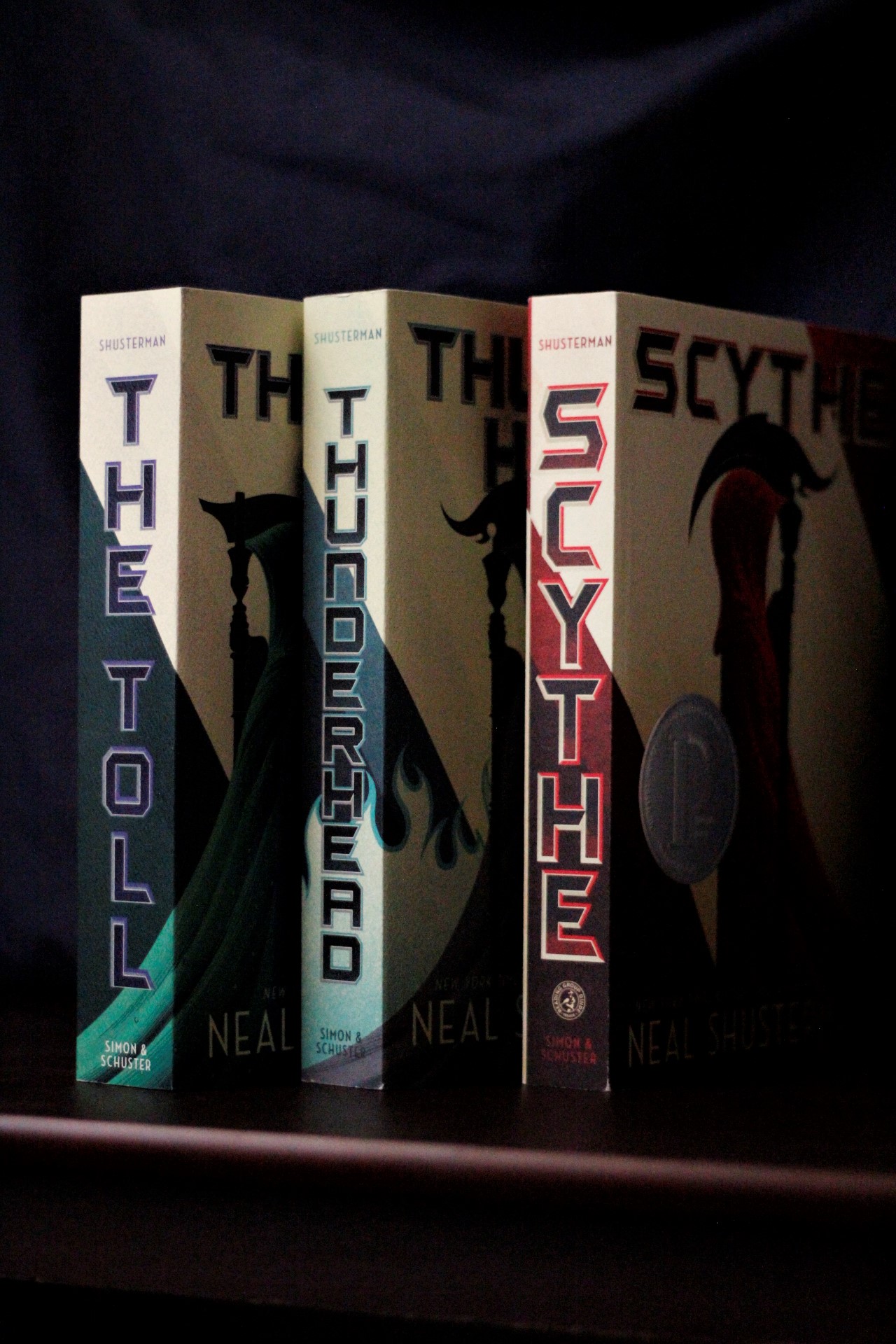
Y’all. When I sat myself down to write a blog post for this week, I was not expecting to do another book review so soon, but I need to be an absolute mess about this series. I love Neal Shusterman. 10000000% his storytelling is one of my favorites out there, and this series, hoo buddy. I haven’t enjoyed a series so much since Lord of the Rings (to be fair to the other series out there, I only read it in its entirety probably three or four years ago, so in reality, I’ve read quite a few other series before Lord of the Rings). Anyone who knows me knows that is a ridiculous amount of love, and I to this day annoy my brother with Boromir dying memes. Never forget the ones you love.
Anyway. Yes. The Arc of a Scythe Series. I was recommended this by someone who’s reading opinions I trust, and she did not let me down in the slightest. I want to go on such a ramble about this set of books, but I won’t because I don’t want to spoil it for those who want to read it. As far as modern fiction goes, I am not well informed. I have my collection of books to read and I don’t really deviate much from them. I’ll add classics and sometimes WWII non-fiction and fiction to my shelves, but very rarely do I branch out and get taken in by more recent leaps into the world of reading. I see all kinds of fervor over the Court of Rose and Something Something series on Instagram, but that’s not my cup of coffeecake. I like action driven, over the top dramatic sometimes, and at the end a very emotionally draining book.
This series has everything in it I love about reading. I read the first one, Scythe, back in January and I had to wait until I had my tax refund to get the second and third one. I read them both over the last three days. They’re not small books. They’re hefty enough that they’d hurt if you had one thrown at you. I regret nothing because I haven’t been so happy with a book in so long and I tell you what I need to ramble.
I went into this thinking I knew what was coming and I am very, very happy to say I was incorrect. What I expected happened in maybe two places, but everywhere else, I was not prepared. The level of intrigue, the level of depravity, it is so far beyond a standard YA fiction to me. And maybe I’m not as up on YA fiction as I could be, but one of the things I was concerned about (and my brother said this, too) was how young the protagonists are. The first book centers around Citra and Roman, two teenagers plucked from their lives to begin training with the ever mysterious group of people called Scythes. See, in this future world, no one dies. The omnipresent being called the Thunderhead has eradicated disease and misery in most forms. People are ageless, and so in order to maintain some semblance of balance (or population control as it’s referred to a few times), the Scythes were created. They are the ones who choose who dies, and they’re beholden to their own set of laws or commandments. The Thunderhead controls the general population, but it cannot have any bearing whatsoever on the world of Scythes. They govern themselves. People are either fearful or indifferent to the Scythes. Most go about their lives not really caring about death until they see a Scythe, and then it all gets real. To be selected for an apprenticeship is no light thing. Once one is chosen to become a harbinger of death, normal life is upended. Family no longer knows how to treat you. People bend over backwards to accommodate a Scythe, often giving them free access to things since they don’t make any money doing what they do. And while people die frequently (there are people who die for fun just to be revived at a revival center. The morbidity of this whole idea of death is so deep it’s mind blowing), no one stays dead. Unless a Scythe gleans a person selected for death, that person is dead. They can’t be taken to a revival center and be brought back from “deadish.” I’d go into more detail, but I really want people to read these books, so I’m going to leave it there.
The first book sets the scene so dang perfectly for the following books. While the two main protagonists are indeed teenagers, they are not left to fend for themselves, and often are in the presence of their mentors, or other fully instated Scythes. Of course, there are a few “save the world” challenges they face, but in the end, the teens work with the adults to accomplish what they must. They’re less burdened with the pressure and it’s kind of spread across the few good people remaining. There’s the standard bad guy who corrupts the meaning of good to fit his narrative, there are religious zealots who cause unmentionable suffering. There’s moments of levity and love. It’s intense in its drive to find the truth in all things, and when the secrets are finally revealed, I admit I held the book high as I screamed in delight.
I will probably read this again at some point, because it’s that good to me, but I will lament I can’t read it for the first time again. It’s a series I will recommend highly to anyone who enjoys reading.
I give all three of these books, individually and together, a 10/10. I’d go higher if I could.
*******I read the 2017, 2019, and 2020 Simon and Schuster Paperback editions*******
 salisbury.fake