Writing Journal #5

I don’t necessarily have writer’s block, I have lack of interest in writing at the moment. I’m still trying to write, though, and so some of the stuff that comes out is useable and other bits are more scrappable.

I am not discouraged by this, though! Sometimes taking breaks is necessary. Give a brain a bit of a rest. I’m doing some reading, though. Currently I’m reading Blood Meridian by Cormac McCarthy, and The Temptation to Exist by E.M. Cioran. I may review one or both of those! May also just read them, haha.

I considered doing a game review of a game I recently watched a playthrough of, but I sometimes feel like a poser when I try to talk about video games. I’m not skilled in the slightest at playing them, so I usually watch games (without commentary). Big, big space horror fan.

Back to writing: I’ve done a few things with the language I made up for the Maker series, like named a metal and started … doodling? I guess would be the word for it, but seeing how sentence structure would work. Different cities would have different structure sometimes, I think, as a way to differentiate their cultures/accents/etc.

I think that’s about all I have in terms of an update for now. Until next time, friends.

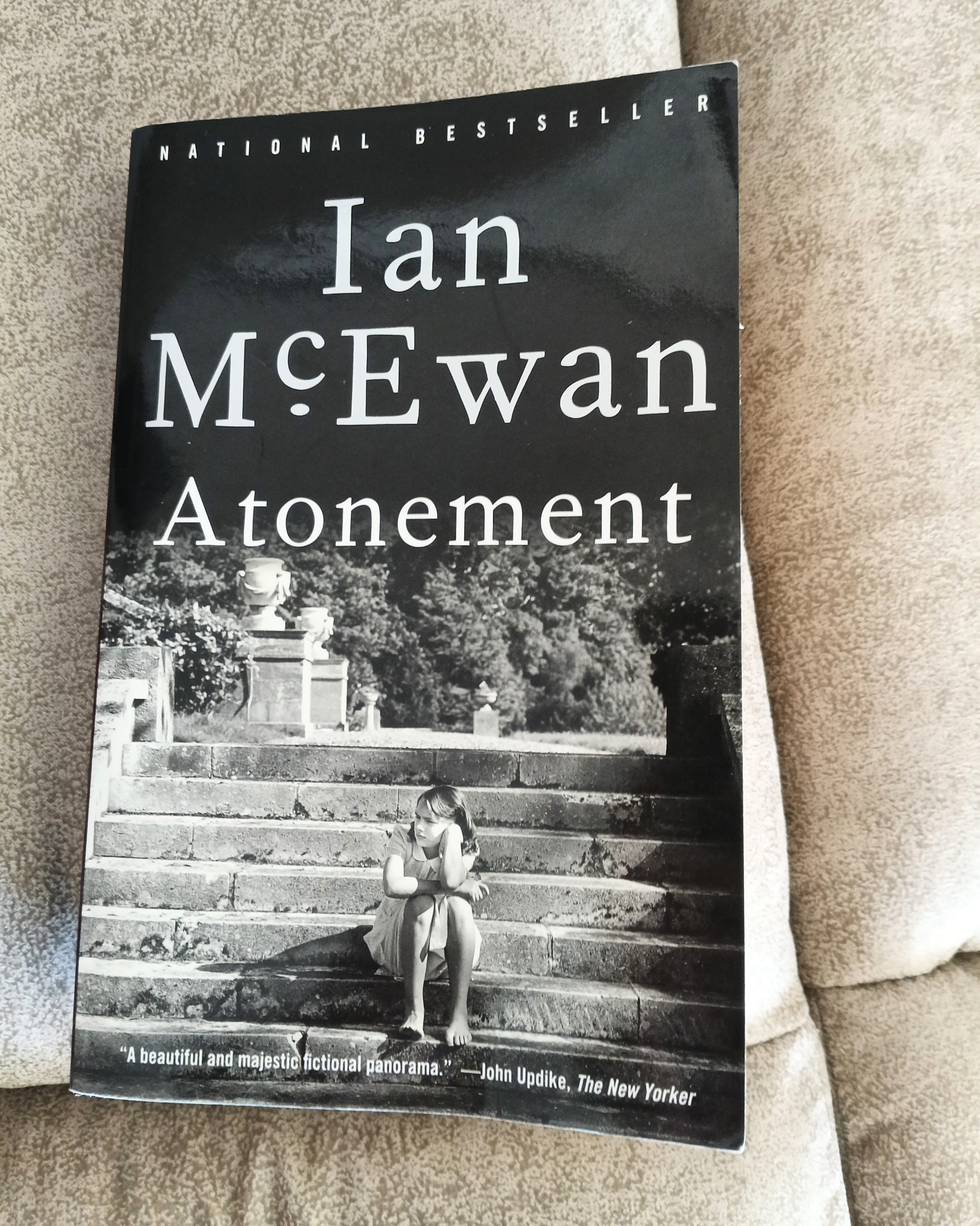
Atonement by Ian McEwan

“It wasn’t only wickedness and scheming that made people unhappy, it was confusion and misunderstanding; above all, it was the failure to grasp the simple truth that other people are as real as you.”

I had this book sitting on my “I’ve read this” shelf and recently went looking for something else when I spotted it. It sat on my “I haven’t read this” shelf for a while because I knew the story already. I’m a big, big fan of the film adaptation of this book, and from the synopsis, it followed the story pretty accurately.

I was not prepared for how deeply beautiful this book is. In the beginning, it’s told from the perspective of a thirteen-year-old girl who misunderstands something she sees out a window. A few more things happen within the space of an afternoon and evening, and as a result of her incorrect assumptions, lives are shifted into irreversible directions.

The film follows the book nearly scene for scene, which I felt incredibly kind of Hollywood. The story is rather important in all its moving parts, as most are, but with something so delicately perched on the bevel of catastrophe, anything left out would render the whole thing meaningless.

In reading some of the reviews, there were several people bothered by the fact the main character, Briony, doesn’t seem to “grow up” over the course of the book. This mainly stems from how she interrupts the rape of her cousin, and because of her false accusations sends an innocent family friend to prison.

The book stays mainly in Briony’s perspective, so we see her grow into a young adult at the precipice of a country at war. She doesn’t take her place at Cambridge, and goes into nursing–like the sister who fled the family on the arrest of the family friend. Briony comments on knowing she was wrong in her youth, and several of the reviewers were upset the rape isn’t discussed past a certain point.

My response to that is why would Briony talk about something that didn’t happen to her? I don’t mean that to sound callous, but as someone who’s experienced sexual violence, I don’t really find it pleasant to discuss. I don’t think the few people who know the situation sit around and talk about it amongst themselves either, so placing a responsibility on the main character to go into such an experience feels a little beside the point. She does eventually attend her cousin’s wedding, and it’s revealed her cousin marries the man who raped her (very much not the family friend). That and a few things Briony says at the end of the book are the only time it’s really mentioned again.

I don’t find it her responsibility to process such an event. McEwan could have written Lola’s perspective into the book, but she wasn’t a main character, and so having her show up to think/talk about her experience would have disjointed the story entirely.

The other thing people commented on was how the whole situation wasn’t important enough for a book. To that, I say, they missed the point. No one wants to read about a wealthy family crumbling because of misplaced accusations and a war. Not truly. But the depth of perspective we get from Briony shows us how penance cannot be achieved perfectly. By the end of the book, she is an old woman and discussing her regrets, so to speak, and what I love so much about it is the vast scope of her understanding, and the pain she has at not having her sister in her life.

I know my opinions are not the right ones. But they are mine, and I see Briony as faulted, someone who caused tragedy and bore the weight of that tragedy the rest of her life. Some would say rightfully so, but I feel like those people forget what it was to be thirteen and not understand the world the way we see it as an adult. We know right from wrong, but if we don’t know the reason or the why for something, it’s hard to articulate the responsibility.

9/10 stars

*******I read the First Anchor Books 2003 paperback edition*******
Where Do I Go From Here?

I feel it poking at the back of my brain, trying to wheedle its way into my skull. To bury itself where it feels most familiar, most comfortable. I am surrounded by what-ifs and why. Can’t you just let me breathe?

I wish I had answers and timeframes, and understanding of the deeper parts of fear. I just have a promise to keep trying. Keep doing. Keep rising out of bed, keep putting my shoes on and still be a person where it’s expected of me.

I want to hollow myself out and climb inside. Wrap the cavity around me and tighten it with screws. Let me get to know the woman I’ve become. Without being asked why I changed. Why I became.

It’s okay not to be okay, of course, but how long do you let that be your maxim? Your guide through life? When does it stop being a thing you tell yourself for grace and becomes a thing you tell yourself to hide?

Hide with me, I beg the moon. Hide away with me from all the sunrises coming for me, so I can stay with the part of me I don’t know yet, the part I’ve been running from this whole time.

Is it right, I ask my back patio, to leave the tired parts of my mind behind, to stand guard against the darkness seeping in through their fingers, while the rest of me pushes forward a brightness I know is false? Is it right of me to do that?

I wish I could tell you, I say to the pillow I tossed onto my mattress last night. I wish I could tell you why I can’t find the pieces. I just can’t.

I’ll keep looking, though, don’t worry.

Writing Journal #4

I’ve been working rather steadily on the first draft of the third book. Lazarus Rising. Not the religious connotations it might seem to have, but kind of? Based purely on Tobias (the creator of Telaroth) liking the story of Lazarus so much he used the name as a way to distance himself from the problems he caused. It goes so much deeper than that, of course, but this book is one of the first we see into Lazarus. Characters go into the sister-world and it is truly one of the coolest places to spend an afternoon in my head.

I am currently doing some typing so I don’t have an entire book to type in a few months when I have the first draft done. But I’m writing chapter sixteen now. Just scootin’ right along.

I’ve been thinking more and more about submitting a few short pieces for magazines/journals/etc, but I know next to nothing about that process. I have a few friends who are regular submitters and they’ve offered advice, so when I get the confidence to start collecting rejections, I’ll implement what I learn from them.

Sometimes I beta read as well, and one of the things that surprises the people I read for is how fast I get it done. So, I’ve considered maybe turning that into a side hustle. Get some dollars for a hobby? I don’t know. I truly enjoy reading through people’s work and seeing how I can help them tell the story they want to. I don’t really do line-edits, but I do broader content and some typo assist. I keep waffling back and forth on asking for money for it, though, because it is something I really do enjoy.

But my father told me once never give my work away for free.

And the part of me that breathes words says the delight I get from doing this kind of thing is the payment I need or even want.

Things to think about, of course.

Aside from that, I have a secret-not-so-secret project looming for the summer months, and I’m excited about that in the sense that it’s a piece I never really thought I’d publish. It’s a romance novel of sorts, and one I’ve worked on for yeeeeears and years. Never putting it anywhere more than a now defunct forum.

I will get the first draft of Lazarus Rising finished, and then work on Daisy while Lazarus steeps. When I get to the fourth book in the Maker series, that’ll be a challenge because I’ve never written a draft–first person or third. Everything else has at least been through a first person POV version. Uncharted territory ahead, and it’s exciting but intimidating all at once.

Thanks for reading this ramble of writing thoughts. Until next time, friends.

Just Do Your Best

I’m not sure how to start this one, so I’m just going to dive right on in there.

When I was a kid, I danced for about nine years. Ballet. I did the whole competition stuff, but I also did a private studio that didn’t participate in competitions. We would dance in local events, though, and there was this Christmas festival every year where members of groups and communities could decorate a Christmas tree and people would “buy” the tree. Proceeds went to charities or something. I might not have the full details on that because I was little and didn’t understand why I danced at this thing, I just knew I did.

One year, I’d asked my dad to be there. I don’t remember why, but it was really, really important for him to be there. He had dental surgery that day, and the pain meds he was given ended up making him sleep through my performance.

My dad arrived at the venue and knelt on the floor and just hugged me so tight and said he was sorry he missed my dance. He even showed me the inside of his lip as proof that there was a reason he wasn’t there. The regret in his eyes and the way he hugged me for what felt like an hour while kneeling on that hard floor, all because he thought he had failed me.

But he was there. He did show up.

I still feel that hug to this day.

I have more dances for him to see. They’re just not ballet. People won’t remember everything about you, but they’ll remember you trying. They’ll remember you being there in whatever way you can. I hope you continue to be here. And I hope you are a little gentler on yourself because you are doing your best.

Writing Journal #3

I’ve finished chapter eight of Lazarus Rising’s first draft. I’m writing from Fogg’s perspective in the beginning of this book, giving him some space to be seen. Not that he deserves such a grace given who he is. Some of the feedback I’ve gotten on Keeper is how dark it is, how violent Frankie ends up being in some instances. I guess I never really saw it as violence if she’s just using what she learns in defense of herself. Because that’s what it all ends up being, self-defense. I suppose I could probably leave some of the finer details out, but what I’ve enjoyed about my writing growth while working on the whole Maker series is seeing how I can use the darker sides of myself to propel a story. How I can give voice to the parts of me that otherwise wouldn’t be expressed. I’m not a murderous psychopath. But someone in my stories is, so I can take them as far as I want to, knowing I am safe from their evilness.

That then begs the question: how much of it is author-insertion? Do I have thoughts of violence? Do I run through the scenes that appear in my books like I want them to be realities? I don’t want them to be real. That’s the beauty of living in fiction, I can put people who don’t exist through extraordinary ordeals to show just how much they can handle–or not handle–and come out on the other side of it. It’s a wonderful thing, the power of creation. I don’t want the world to burn in reality, but I can sure write it doing that very thing in a book.

I’m going to keep going for tonight, and get as much done in chapter nine as I can. I’m almost done writing Fogg’s bit, and then I’ll have a chapter interlude for the Unbound, and then it’s back to Frankie. The page number formatting for this is going to be a nightmare, but I will get it done.

And that’s all I have for you today. Until next time, friends.

Timmy In the Well – a poem

I wish I could be seen with eyes
that know the reason why
I hide my smiles behind
questions I leave unanswered.
So you think you have
the knowledge of my spheres,
when I have buried so deeply
the things I love about myself
to keep them safe, to keep them mine.

I think I remain alone
so no one finds the pathway
through the labyrinth, the hedges
of superficial vulnerability
I install so no one sees just how
far my aching runs, how dark
it is in the permafrost I brick
around my heart; so no one
ever sees how hard I try
to be happy.

Writing Journal #2 – Description

Back when I was a wee writer lass, I used to spend a lot of time on what I now consider “unnecessary description.” We’ll get into that here shortly, I just want to put a disclaimer of sorts here that I am not saying the writers who do this are bad. There are audiences for pretty much any kind of story written. I will also say when I was a younger reader, I did sometimes prefer the description I’m about to go into. As I’ve gotten older, however, I find it is less satisfying to have such direct references and specifics in a story. I like to wander a bit and imagine with some of the vaguer choices.

What I mean by direct references is the name-dropping of brands of clothing, specific types of furniture, exact songs playing during a moment, the color of the paint on the walls, the down-to-the-very-last-detail of the kitchen.

Telling me the main character is wearing Converse is only important if that plays a massive part in their characterization for the whole story. “Black and white shoes worn to the point of needing tape to be held together” indicates the importance of the shoes far more than the brand name does. The fraying, dingy shoelaces, old sharpie drawings of stars and smiley faces. These shoes are beloved, and it is far easier to see that through the description than being told what it is.

It’s the same as giving me a specific song playing in a moment. Unless that song becomes pivotal to the story later on, don’t tell me what song it is. I think book playlists are marvelous because it gives a vibe, but it doesn’t force me to think of a specific song. Giving me the opportunity to see a scene and feel it through the more purposeful description, such as “vibrant violin music played softly in the corner on an old record player” allows me to sink further into the moment far more than “Vivaldi’s Winter was playing.”

One of my favorite books of all time, I Capture the Castle by Dodie Smith has this magnificent moment where the main character is dancing with her sister’s betrothed, and she loves the piece playing, but she doesn’t find out what it is until after the dance has completed and a major moment happens for her. Debussy’s Clair De Lune is also mentioned, but again it’s after being described by the main character within the context of the moment it’s happening.

To reiterate, I don’t necessarily think there’s anything wrong with using direct descriptions. There are audiences for such a thing, but I find it’s so limiting while writing, and relying on those specifics kind of takes away the wonder of a really good description.

This is a ramble. If you made it this far, thank you. I’ll see you next week.

Writing Journal #1

One of the things I plan on using this blog for now is a kind of writing journal, where I drop all the stuff I’ve worked on during the week/day/lifetime/etc. For this inaugural entry, I give you:

  1. Finished chapter three of the third book in the Maker series (first draft)
  2. Wrote a personal essay that may or may not be a future blog post
  3. Doodled little scenes between two of my main characters.
  4. Outlined in my head a few ideas for a romance novel I’m looking to get printed this year. It won’t be offered for sale, but I want a few people to have it, so I’m going to do that one for myself.
  5. Considered once again putting together a compendium for the language I made up

And that’s all the tales I have for you from this week. I did start chapter four of the third book (Lazarus Rising), and I’ve started with the perspective of a different character for this one. Usually it’s Frankie being front-and-center, but this time we’re starting with Fogg, baby. The first section of the book will be his perspective, and we’ll see some of his backstory and some of the current events being unleashed now that certain things have happened.

Thank you for stopping by. I hope you are doing well, and if you are not, I hope it stops being a beshmapasen for you soon.

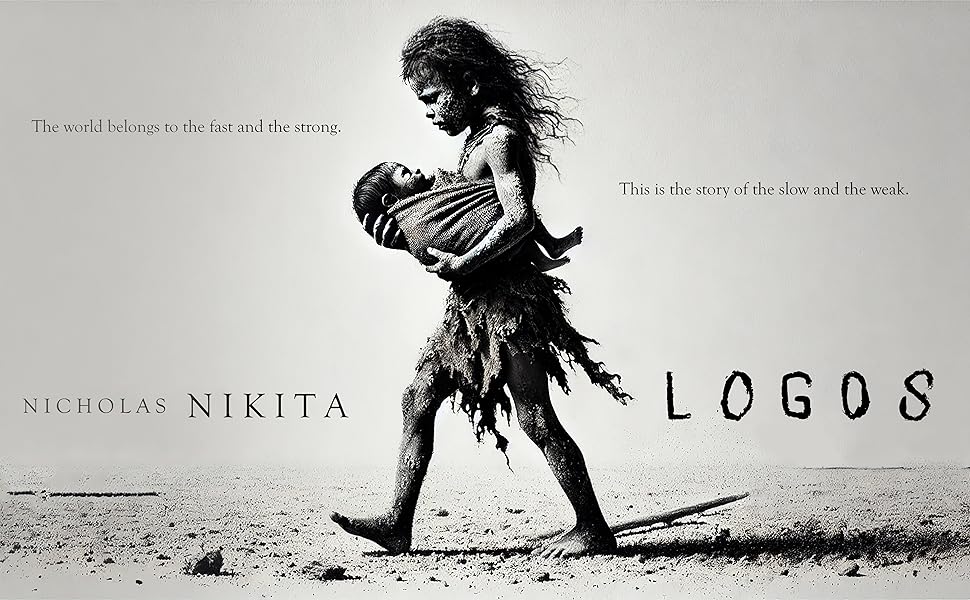
Logos by Nicholas Nikita

Image taken from Amazon.com e-Book

First read of the year and it’s a dang doozy. I found this while browsing the genres in Kindle Unlimited and the premise intrigued me enough to pop it in my library. It was a quick read in that I was able to read it in a few hours. The time it took me to read it should not detract from the quality of the story being told.

Logos follows an unnamed boy for the majority of the book as he survives a primal land. He loses his parents to the night-beasts, and saves his newborn brother. The first part of the book covers the brothers purely surviving the harsh landscape as they travel to the mountains, where the eldest believes their parents are waiting with the sun god, Aeos. It shows the desperation of people simply trying to live, where water and food are dangerously scarce. The boys are attacked by men and beasts over the course of their journey, and when they finally reach the mountains, the boys are old enough to be considered young adults (or that’s how I read them to be). Lightning strikes a tree and starts a fire. This fascinates the boys and they cultivate the fire, feeding it so it stays alive. The youngest convinces his brother to keep it large enough to be a signal to others in the vicinity, hoping their curiosity about the light and smoke will bring people to them.

The rise of this community is such a fascinating look at how socialization works. The boys are considered gods because they can hold the fire (on a stick, without burning their hands), and they can carry the fire. This sets up a dichotomy between them where the eldest becomes the more determined to build solidarity, to have sameness. Make sure people can speak the same language, ignoring the fact he’s bulldozing over other languages and practices in favor of his own creation. The boys are given names, Leos (the younger) who wears the skull and fur of a lion he killed, and Ra who wears the skull of an eagle (or some other large bird) he battled.

There is an inevitability toward the end I won’t spoil, but what I liked so much about this was how clear the progression of understanding and coherent thought became as the story went on. The boys grew into men and their minds became their own, and that strong characterization showed how even when the world is full of unknown dangers and death, the more their minds worked, the more the world made sense.

I don’t feel as though I’m properly explaining myself because it felt like recognizing something from before, like there’s an inherent desire to be. The brothers went in different directions with their curiosities and understandings of the same world they were presented. The eldest had far more experience in the danger than the younger, and so his was caution until it became maniacal. The youngest had the innocence of curiosity unfiltered by those experiences.

I think this was a solid book to start the year off with, and I recommend it. It is rather dark and depraved in places, but I found that added to the primitive nature of the world in which the brothers lived. When one exhibits too radical a deviation from the comfort of routine, the other offers a balance and a command to return to familiarity. By the end, it’s a book about a boy trying to do the best he can for his little brother. It’s a deeply thought provoking book. I give this 8/10 stars.