“If God meant to interfere in the degeneracy of mankind would he not have done so by now? Wolves cull themselves, man. What other creature could? And is the race of man not more predacious yet?”
I was 102 pages in when the violence finally made me pause. It was a long pause. I don’t usually annotate books I read, but this one I started underlining and writing in margins (in pencil, as I’m not an entire heathen). My note on page 102-103 is, “this is the first instance where the violence struck me. Up until now, it’s almost been a desensitization, but the nonchalance of Glanton and the visceral description of the woman’s death is such a stark interjection within the sleepy atmosphere.”
Glanton, the person I’d consider the main antagonist of this book (although others would call the Judge the antagonist, but we’ll get to him), kills this old woman by pointing one direction, and once her head’s turned, he shoots her point blank. Before this moment there are dozens of descriptions of violence, but it is the taciturn way in which Glanton takes this life that caught me so abruptly I had to step out of the story for a few days.
I read this whole thing slowly.
I needed to take my time with it because of a few things, but the biggest reason is how comfortable with the violence I got while reading. It’s a morbid lullaby, the way it weaves in and out of the ride through the untamed West. It seeps into your bones as you read, reminding you that you are part of it.
It brought me back to how I felt about Tender is the Flesh last year, where I felt like I’d been the one to do the killing.
Page 142: “The leaves shifted in a million spangles down the pale corridors and Glanton took one and turned it like a tiny fan by its stem and held it and let it fall and its perfection was not lost on him.”
My note: “Glanton noting the perfection of a leaf is such a stark contrast to him killing the old woman a few chapters ago.”
That is where I decided Glanton was the villain of this book. A man without true empathy wouldn’t be able to recognize the absurdity of pondering the machinations of a leaf while having spilling innocent blood.
Page 184: “They passed through small villages doffing their hats to folk whom they would murder before the month was out.”
My note: “How many people were killed during this time? How many forgotten because no one was left to remember them?”
McCarthy is an acquired taste. He’s known for his rambling passages and infatuation with leaving punctuation out of his life. He has wisdom in his words, but sometimes it’s so buried within the mire of his writing style that one has to attempt multiple readings.
This is not a book to read twice. It left me feeling heavy and empty at the end of it. All the violence, for what? To prove he could get away with it under the guise of literature? It’s very much a book that people say they love because it makes them sound and feel edgy. Like they’ve seen some things, man.
Not everything needs to be a contest of sufferings.
There’s such an absence of emotion from most of the characters as they go around killing for their government. Getting rid of the people there before them. It leaves a sour taste all through my digestive system as I try to empathize with any of the riders in Glanton’s crew. The one I could not find any sort of understanding for was the Judge.
He and Glanton are made for each other in their insensate glorification of the blood they spatter. The Judge is the metaphor for the Devil, I assume, although I would say he’s the one who acts on behalf of the Devil, who as I said before is Glanton. But the darkness inside the Judge is a level that had me react physically to several of the lines he said.
Page 207: “Whatever exists, he said. Whatever in creation exists without my knowledge exists without my consent.”
And shortly after on page 208: “The freedom of birds is an insult to me. I’d have them all in zoos.”
In all the books I’ve read in my life, there are two villains I’ve come across: the broken and the batshit. The broken ones, I’d toss Glanton in that category. He’s got a smidgeon of humanity in him because even though he doesn’t care what happens to the men on his crew, they are his crew and he treats them with a modicum of respect.
The judge is the one I’d put in the batshit category. He says some of the most unhinged garbage I’ve ever read, and he says it with such an authority behind it. Like he knows that someday someone will find what he’s spoken and will choose to live by it. He believes himself invincible. One has to be crazy to truly believe that, right?
There is a plot to this book, somewhere. What it is, I don’t know that I could say it’s linear. It’s more of a character study, where the Kid is placed in unbearable circumstances right from the beginning. It’s a test of who we really are at the end of whatever day. Do we stand by and allow ourselves to be swept into the current of hell racing toward us? Or do we fight that flushing of refuse and black bile back? Do we dig our feet into the earth and demand that darkness do its worst?
We do not have to be heroes, but we have to be able to look at ourselves at the end of this romp through the meadows of life and say we were our truest selves. That no one ever made us compromise on who we are for safety. For the luxury of silence.
7.5/10
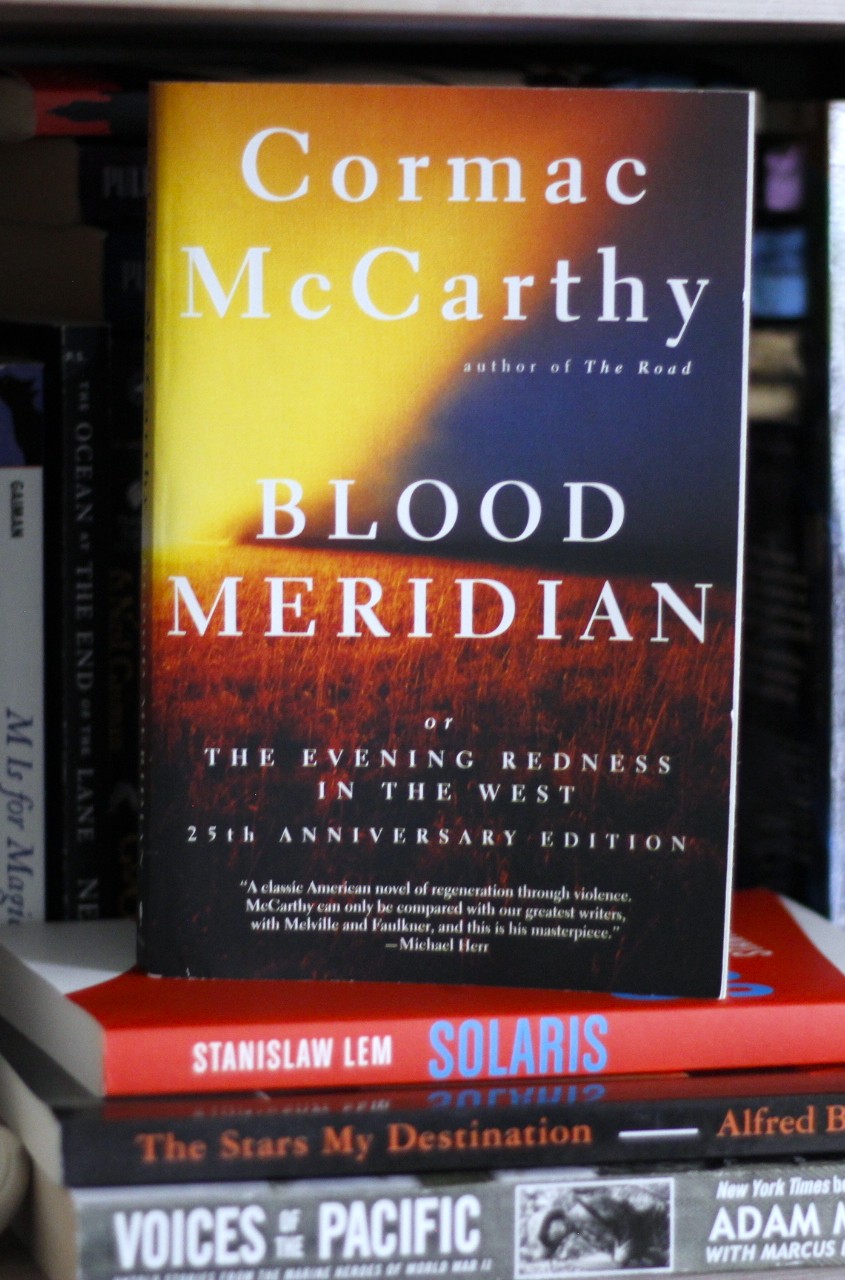
*******I read the 1992 First Vintage International edition*******
 salisbury.fake