I figured why not start with a bang and go into the books I either liked the most or had a lot of thoughts about in 2024. My grand total of books read was 93. I did not, in fact, finish reading The Fires of Heaven by Robert Jordan like I promised my brother I would, but we’ll get into that later. The books I’ve chosen for this list are the ones that stuck with me throughout the whole year. Most of these I read months ago, and some I finished far earlier in the year, and they still stick with me.
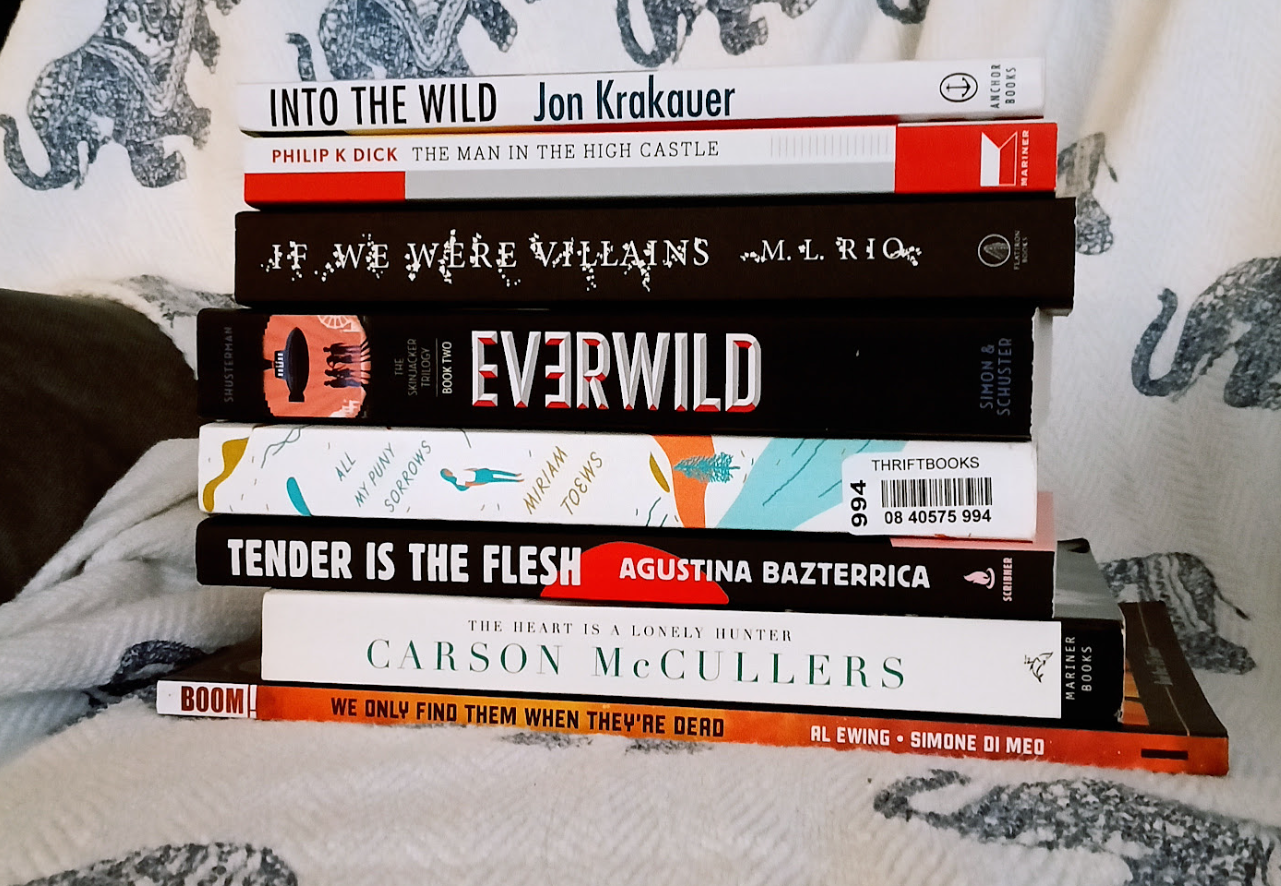
1. Tender is the Flesh by Agustina Bazterrica
I feel like I need to say that if you are not the kind of person who reads heavy topics, this is not the book for you. A lot of the reviews I read of this said that it was disgusting and horrific and I feel like they missed the point of it. This book is not one to enjoy, necessarily. It’s one to make you think way too deeply about the state of humanity. It is a plunge into how people treat others, and that is such a superficial approach to it. It’s societally accepted cannibalism. There are humans bred specifically to become meat for other humans to consume. There are laws in place to “protect” the meat, and there are other things surrounding the “rights” of the ones being used to feed the masses. It’s told from the perspective of a production plant manager (I don’t remember his title officially) who’s dealing with his father going through Alzheimer’s, and a host of other issues both personal and professional. I will say that by the end of this book, I felt like I’d participated, and if you’ve read it, you know what I’m saying because the ending just left me bereft for a few days. I immediately recommended it to some of my friends. It is a purposeful calling out of people who mistreat others and also a scathing commentary on how society is structured. I gave this book 9/10 stars.
2. The Man in the High Castle by Philip K Dick
This book is on the list because it disappointed me and I’m still thinking about the ways it did and how it could have been better. I’ve not read any of Dick’s work before, so this was my introduction, and I was left wanting. He presented this incredible “what-if” scenario and then left it to the imagination for most of the events happening. So much of it occurred “off-screen” and I found that incredibly lackluster for such a stunning approach to alternate history. Especially since it’s for WWII, which has been a topic of debate ever since people realized they could theorize about the “what-ifs” of history. I started reading it because I watched the first episode of the show of the same name, and this is one of the few times I’ve uttered “the visual media is better than the book.” It gives substance to the ideas Dick presents in his book. It shows us the battles, the intrigue that’s hinted at within the subtleties of the writing. I’m glad I read it so I could see what it was, and I’m glad I watched the show (haven’t finished that yet) to expand on what the book could have been. I gave this 5/10 stars.
3. Everwild by Neal Shusterman
The second book of the Skinjacker trilogy by Shusterman made this list because it was the one that stuck with me the most. I think one of my favorite things about Shusterman’s storytelling is he invents new ways to approach death, which is such a difficult topic for anyone to discuss, but especially young adults. I do think sometimes the romances are a little unfinished and rushed into, but if that’s the only critique I have of his writing, I’d say that’s all right. I don’t know if it’s my appreciation for his writing that makes his books appear on my “that’s my favorite” lists, but there is something about his approach to illuminating the dark places of sadness that keeps me personally afloat when I could very easily sink. The trilogy as a whole is a stunning tale of lost children, and some of the ways they “go into the beyond” left me nearly weeping. This story is one I will think on, much like I think about his Arc of the Scythe series. I gave this book an 8/10 stars.
4. Into the Wild by Jon Krakauer
Ohhhh, this one broke my heart. This is the journalistic telling of Christopher Johnson McCandless, the young man who went into the Alaskan wilderness with nothing but a ten-pound bag of rice and serious hopes and dreams, and ended up losing his life due to some unconfirmed circumstances. He wasn’t murdered, but there is speculation he ate some poisonous seeds while he was already weak from malnutrition and he couldn’t survive. Krakauer retraces Christopher’s journey to this epic adventure, and he meets the people who were impacted while the young man was finding his way to his eventual demise. Several people called him an idiot, saying he had no business being in the wilderness with so little experience, some called him noble for following the passions of his heart, and his parents and family missed him terribly. Christopher burned bridges he didn’t need to, for reasons only he knew, and I think the hardest part of this story was seeing how his determination to do what he saw as necessary only alienated him from people who genuinely cared about him. It wasn’t so much the societal obligation of family, his parents legitimately worried about him and his sister lost one of the people she was closest to for a myriad of unknowns. Some people criticized Krakauer for glamorizing this tale, and I can see where they’re coming from, but for me this wasn’t a glamorization. It was a caution to be passionate, but be intelligent in passions that can kill you. Even the most experienced of wilderness dwellers can run into situations of extreme danger, and they will need to rely on their in-depth knowledge to survive. I admire Christopher’s drive to be who he was. I just wish the world had gotten more of it. I gave this book 9/10 stars.
5. If We Were Villains by M. L. Rio
If you don’t like Shakespeare, this is not the book for you. The characters quote it pretty much every page and it is a serious, dark tragedy being uncovered throughout the course of the story. It’s told in flashbacks, with present day scatterings throughout, and that format works well for this. A group of theater students at an exclusive college for the arts forms a tight bond. Their friendly rivalries become dangerous, however, in the last year. The opening night of their final performance, something horrible happens, and one of them is killed. Was it an accident? Self-defense? Malicious? Even flipping through it now to write this post, my throat is closing up on tears trying to escape for the sadness inside this book. One of my quotes for the year comes from within the pages, said by a character toward the end: “Nothing is so exhausting as anguish.” I loved these characters, and I was broken hearted by the time I finished this book. It was beautiful and I gave it 9/10 stars.
6. We Only Find Them When They’re Dead: Book One, the Seeker by Al Ewing and Simone Di Meo
I love science fiction. Once I discovered how vast a genre it is, my entire world opened up. Reading, yes, but also writing-wise. It encompasses the biggest part of being human: curiosity. There is curiosity in most genres, but in science-fiction, there are literally no limits. You can go into space, you can dive to the deepest pits of the ocean, and you can give it all a name that only makes sense to you. What I don’t love about science-fiction is how people tend to send their characters into space and then have them get spicy on a spaceship. There are several other things I dislike about modern science-fiction, but that is for an entirely different blog post. What this book did for me was give me the delight of curiosity I’ve hungered for. Humanity’s only food source is the bodies of dead gods that appear throughout the universe. One captain decides to find out where the gods are before they appear. This trilogy of graphic novels is stunning, both in art and storytelling. The characters are diverse and multi-faceted. They bring humanity into space and do something with that instead of arguing solely about politics and who owns what. There is some political arguing, but that’s simply the nature of the genre. I loved this series, and this part of it was incredibly magical for me when I first read it. I gave it 10/10 stars.
7. All My Puny Sorrows by Miriam Toews
Have you ever put a book on your list to read only to let it fester because you know it’s going to take a lot of your energy to read it and you don’t want to give those emotions much space just yet? That was this book for a few years. It’s been on my to-be-read shelf for at least three years, and I finally decided to read it. It’s about two sisters, one a concert pianist with a determination to die, and the other a single mother trying to keep everyone around her alive. The book hits on themes and thoughts I personally have had, both sides of the disease of depression, and I think I knew reading this one would be hard for me. It’s freeing to see your own thoughts on the page written by someone else, but it’s also incredibly exposing and leaves one feeling vulnerable to everything horrible. I read this book hoping it wouldn’t end the way I expected it to. I won’t say whether it did or not, because I don’t want to spoil it, but I will say it is worth the difficulty of being seen. I gave this book 9/10 stars.
8. The Heart is a Lonely Hunter by Carson McCullers
Even typing the title, I’m trying not to cry. The moment I finished this book, I wanted to ask Henry if he’d read it. McCullers published this when she was 23-years-old and I have never read anything by anyone that young who understood what it is to be human so clearly and purely. I initially wanted to read this book based on a quote I read probably a decade ago, “the way I need you is a loneliness I cannot bear.” I have it on an index card hanging on my wall right now, and it’s been on every wall in every place I’ve lived since I found the quote. It’s haunted me, and now that I have the context for it, I am not entirely shattered from it, but I am a different person in some ways. This is, without hesitation, one of the best books I’ve ever read in my life. It is about surviving life alone, surrounded by so many people. It’s about being a kid without understanding why the adults are so serious, until one day you do. It’s about wanting to be heard, but no one can fully know the depths of your knowledge because they don’t have the experience you do. It’s about trying to do right by children who grew away from everything you taught them. It’s about love, the purest kind, and it’s about longing. To be held, to be seen, to be. This book is a gift, and I will love it always. 10/10 stars.
And that is the list I have. This is a long post, and I probably could have broken it into parts, but that’s not how I feel like living life today. I have reading intentions for the year ahead. I wanted to read 5 non-fiction books this last year, and I did. I want to continue that and make it a tradition this new year. I want to finish The Fires of Heaven because I do want to read the whole Wheel of Time series, but this one is the least compelling of the ones I’ve read so far. Rand is so annoying. I’ll probably post some book reviews this coming year, and I will absolutely be returning to the blog more frequently.
If you made it this far, I hope you are doing well. If you are not, I hope you are able to find some peace, inner or external, either one I wish upon you. You were not born to this world to suffer. Thank you for being here, and thank you for taking time to read this list of books that made my 2024 a solid year.
Until next time, friends.
 salisbury.fake