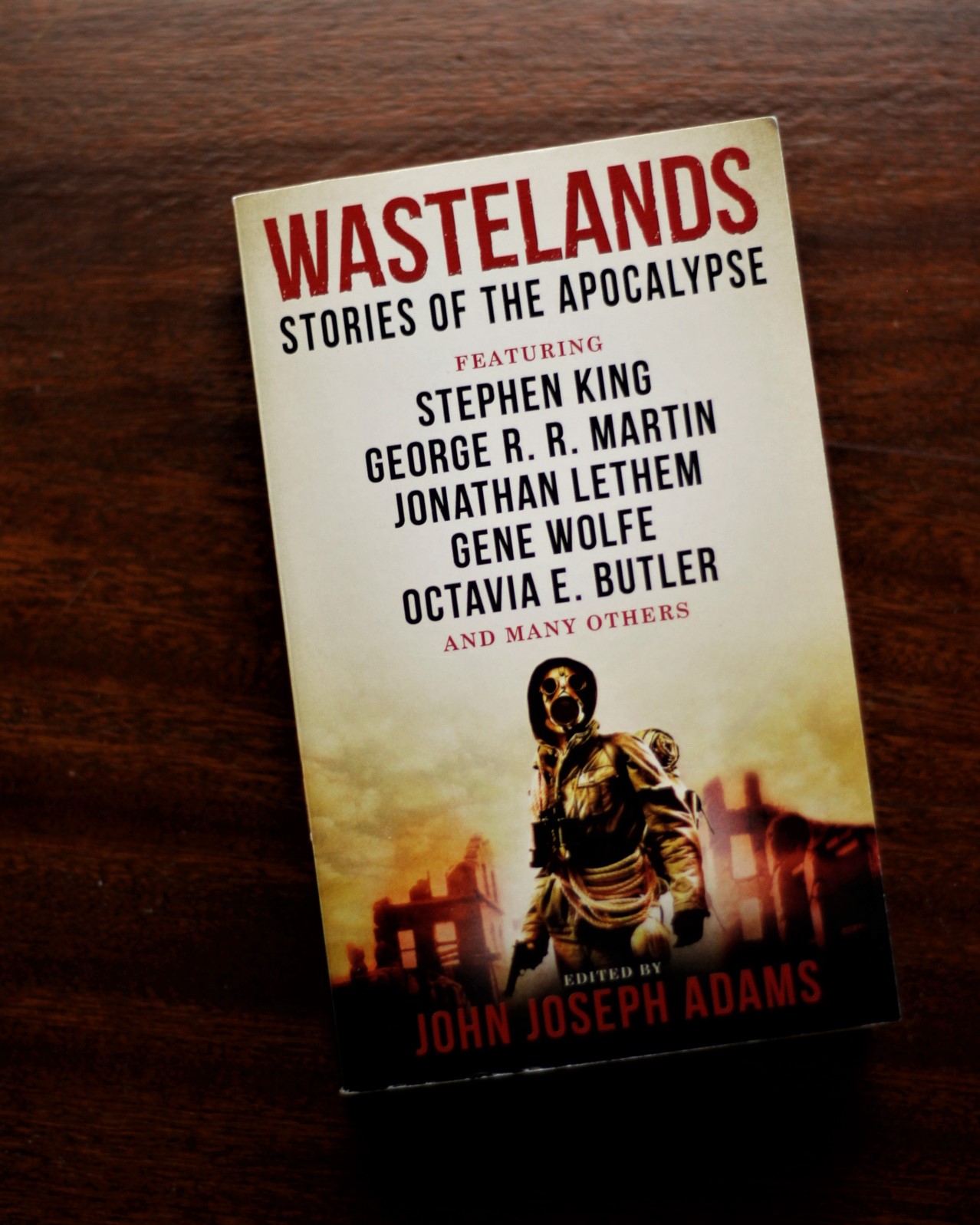
Hey. How’s it going? Doin’ all right? Weather’s getting nicer. Finally. Today we’re talking about a collection of stories I picked up as research for some of my own work, and eventually just read it for enjoyment. Everyone has an apocalypse theory. A reason for why the world will end. Plague, natural disaster, humanity eating itself. Endless possibilities. It’s difficult to write a review for a collection of stories as a whole book, so I’m going to give my thoughts on the ones that stood out to me. The big draws for this book are obviously Stephen King and George R. R. Martin, but only one of those big names had a story that stood out to me. So, let’s get in to it.
There are 22 stories in this collection, and I’m going to touch briefly on eight of them. These are the ones that I’d consider the better of the tales being told, but that’s not to say the others don’t have their merit. My preferences tend to be on the more emotional side, the more “hit in the feels” kind of storytelling. That said, the opener for this was Stephen King’s, and I felt nothing for it. He’s not someone I actively seek out to read, and that’s not me trying to say he’s a bad author. He has a massive fanbase, and my opinion is more like a bloop in the ocean. My first choice of story that stood out, hah, is:
Dark, Dark Were the Tunnels by George R. R. Martin
This story centers on Greel. Greel is a man. He’s what’s left of humanity on Earth after the apocalypse forced most others off the planet. But the others have come back. What happens is a misunderstanding of the new life on a radiation ravaged planet, where life began anew underground. It feels almost like a commentary on the differences between cultures being mistaken for aggression, and instead of waiting to figure out a compromise or a way to communicate, it escalates to fatal proportions. It does have an expected feel to it, where as reading it becomes fairly obvious what’s going to happen, but I still found myself thinking about it after I’d finished. One of the things I like about Martin’s style is his descriptions. He’s very good at showing exactly what he wants you to see. I give this story an 8/10.
Waiting for the Zephyr by Tobias S Buckell
Mara is the girl who knows there’s more to life than her small town offers, and this story is all about that hope. One of the shorter stories in the collection, that doesn’t take away from the power of that hope. This story deals with expectations of small town life (I say small town, but really it’s more like a spot of life in a desert), and the ambitions of someone not willing to be tied to that life. It’s written well, and Mara is memorable. I give this story a 9/10.
Never Despair by Jack McDevitt
Another short piece of the collection, this is almost on the same level of optimism as “Waiting for the Zephyr.” It follows Chaka as she goes in search of answers. The world’s ended, obviously, and she wants to find out more, to understand what happened to those who’d gone before. Chaka talks to a projection of Winston Churchill, and they have such a charming conversation. That may sound sarcastic, but I don’t mean it to be. It’s really almost like a granddaughter telling her grandfather about her day at school. It’s in this story that my favorite quote of the book can be found: “The turnings of history are never directed by crowds,” he said. “Nor by the cautious. Always, it is the lone captain who sets the course.” I give this story an 8/10.
Artie’s Angels by Catherine Wells
This is the first one that kind of made me sit back and contemplate life for a while. It’s about a rough neighborhood and turf wars (that’s my very basic level description, it’s more than that), and a hero trying to live out a dream. It’s got the desperation for something more than what the world is offering, the frustration at never being enough for that success, and just so much more to it. By the end, I wanted to spend time with the people who matter to me. To ease the loss of something that wasn’t real in the first place. I give this story a 9/10.
Inertia by Nancy Kress
Holy balls, this one knocked me backward. It was a bit predictable in some places, but by the end of it, I was ready to go to war and fight battles for people that didn’t exist. It’s the story of an old woman in a neighborhood cordoned off for being a colony of diseased people at the end of the world. There’s lots of talk of “before,” and there’s lots of talk of how to make life better for everyone inside the colony. The best line from this story is, “She cannot change the world. It’s too old, too entrenched, too vicious, too there. She will fail. There is no force stronger than destructive inertia.” I give this one an 8/10.
Speech Sounds by Octavia E Butler
I feel like when Adams was putting this collection together, he saved the best stories for last, because this one is almost perfect. It takes a look at the scenario almost like the Tower of Babel from the Bible, where language fails at the end of the world, so no one knows how to speak properly or really communicate well. Grunts and hand gestures mean different things to different people. There’s no real way to say what is meant. Except for the main character, Rye. She can speak, which is a rare thing and seen as dangerous. It’s something she keeps to herself. The story would be perfect if there weren’t a lag in the later quarter of it. I give this story a 9/10.
The End of the World As We Know It by Dale Bailey
This story is almost meta in the way it calls itself out for being a story about the end of the world. It approaches the topic from the point of view of a lone survivor of some mysterious thing that’s caused everyone to die. He roams the leftover world to find something of a purpose, and it’s just pure desolation. I like this one because it gives a bit of a different perspective on apocalypse stories while still being cliche at places. I give this one a 7/10.
A Song Before Sunset by David Grigg
In the whole collection, no story ever made me close the book and set it aside because of the despair the apocalypse usually brings. Until this one. I would have cried if I’d let myself think about it too much. It follows Parnell, a man who lives by himself in a rundown city. It’s rough, as these stories are, but for Parnell, he tries to hold onto the beautiful things. The books, the art, the music–all past things now essentially obsolete because no one has a need for beauty in a broken, dead world. Parnell finds a way to get into a concert hall where a grand piano is waiting on the stage for him. He used to be a pianist. He trades with a kind of “general store” merchant, the Tumbledown Woman, for tools to repair this piano. And he plays it. There is a huge undercurrent of “what do we do with the beautiful things when the world ends?” running through this, and it is an excellent question. Because there will always be reason to hold on to the beauty, the bits of the past that aren’t useless, not entirely. But there will also be a need for necessity. It becomes a delicate balance of what is needed for survival and what is not. Practicality over frivolity. This story felt the most apocalyptic to me. I give this one a 10/10.
Episode Seven: The Last Stand Against the Pack in the Kingdom of the Purple Flowers by John Langan
The last story in this collection was one of the more interesting stylistically. I’ve never read work by most of the people in this, but I was not prepared for this one. Written entirely in one sentence over the course of forty pages, I was ready to hate this. Episode Seven is about a woman and her best friend running away from a pack of hyenas (maybe hyenas? I don’t think it was fully said they were hyenas, but they were animals like hyenas). These animals are smart and tracking them through all kinds of terrain, and all kinds of metropolitan destruction. There’s an added level of fear for her because she’s also pregnant and nearing the end of her pregnancy. Her best friend, Wayne, somehow knows all the things he has to do in order to help them survive in the busted up world. But there’s something not quite right about him. Something has been off the entire time, but she’s been unable to figure it out. I loved the ending of this story, and by the time I’d reached it, I hadn’t paid too much attention to the punctuation situation. This was a fun thrill ride of a final story, and I think it gets an 8/10.
*******I read the 2015 Titan Books paperback edition*******

 salisbury.fake