Brought To You By Powdermilk Biscuits

“Don’t be so hard on yourself,” they say,
their hands poised to slap me.
I know they think I’ll fight back,
but I won’t.
I gave up years ago
when my father left us
for the theatre
(I think that’s what we called it)
and I let the fight in me
go with him
because he’d need it
to get me to love him again.

Disclaimer: this is not about my actual father

The Power of Habit by Charles Duhigg

Technically I haven’t finished reading this, but I reached the appendix and the notes, so I’m going to discuss my thoughts on this book today. When I picked this up, it was kind of on a whim. The title caught my eye at the store, and the yellow grabbed me, too. I’ve been struggling with personal habits lately, so I thought this would be an interesting perspective to read through. I was right. This book is incredibly readable. Typically when I grab non-fiction, I struggle to read it because it’s very factual and very thoroughly researched (hopefully, anyway). That’s not to say this isn’t well researched or full of facts, because it is that, but Duhigg approaches it from a reader perspective. Something I feel non-fiction writers tend to forget is how to appeal to readers of all genres and types. They get caught up in the truth they’re telling and the presentation is much like a lecture hall PowerPoint by someone at the end of their career and they’re waiting for retirement.

This is not the case for Duhigg. He starts with a story of a man with short term memory loss who can’t tell you where he lives, but he can go on a walk at 2 pm every day and still end up at home without knowing why. There are several intriguing studies presented throughout the book that made me realize I know very little about my own brain. He goes through how Febreeze became a household name, and how stores can predict your buying habits by going through your purchases when you scan your rewards cards. Something stores may not want put in the public eye, but while that’s creepy, it’s also incredibly fascinating.

The first part of the book focuses on individual habits, why we do what we do (which is the sub-title of the book). We create what’s called a “habit loop,” which consists of three parts: a cue, a routine, and a reward. As we receive the same cue, then follow the same routine, and expect the same reward, a habit is formed. This is true for negative habits, too, which makes sense because even though we don’t typically think of the negative outcomes as rewards, they become ingrained as part of the routine, so we follow them. Sometimes unwittingly.

I’m not saying this book has changed my life completely, because I still have habits I consider unhelpful to the person I want to be, but it’s certainly opened my mind to a new realm of understanding. One of the key factors in habit change is belief. Duhigg uses the coaching style of Tony Dungy to approach the topic of belief and he talks about how no matter what Dungy did, the teams would revert back to their old habits in times of stress simply because their belief in the new ways faltered. This is honestly the stage of change I struggle with the most.

This last year I’ve been trying to revamp my thought processes–before I read this book, even more so now–and the process has been almost excruciating. I’ve spent almost 2 decades hating myself, and trying to switch gears and think differently feels like an impossible thing. But that’s the thing about it all. It isn’t impossible because I’m doing it in small ways here and there. I’ve talked about how my depression manifests itself as dishes to wash and laundry I move from hamper to mattress back to hamper. Well it still does, but not as badly. My dishes are never more than a few days left unwashed, and I fold my laundry within a day of doing it. I don’t know specifically what changed my brain to do this, but somehow I’ve convinced my depressive side that this is unacceptable and there needs to be something different we do when I get caught up in my head for too long.

I think this book is worth a read if you’re interested in habits, but I don’t think it’s a book everyone should read. Some people are living their best lives and have no need to go this far into their own heads. I give this book an 8/10.

********I read the 2014 Randomhouse Trade Paperback edition*******

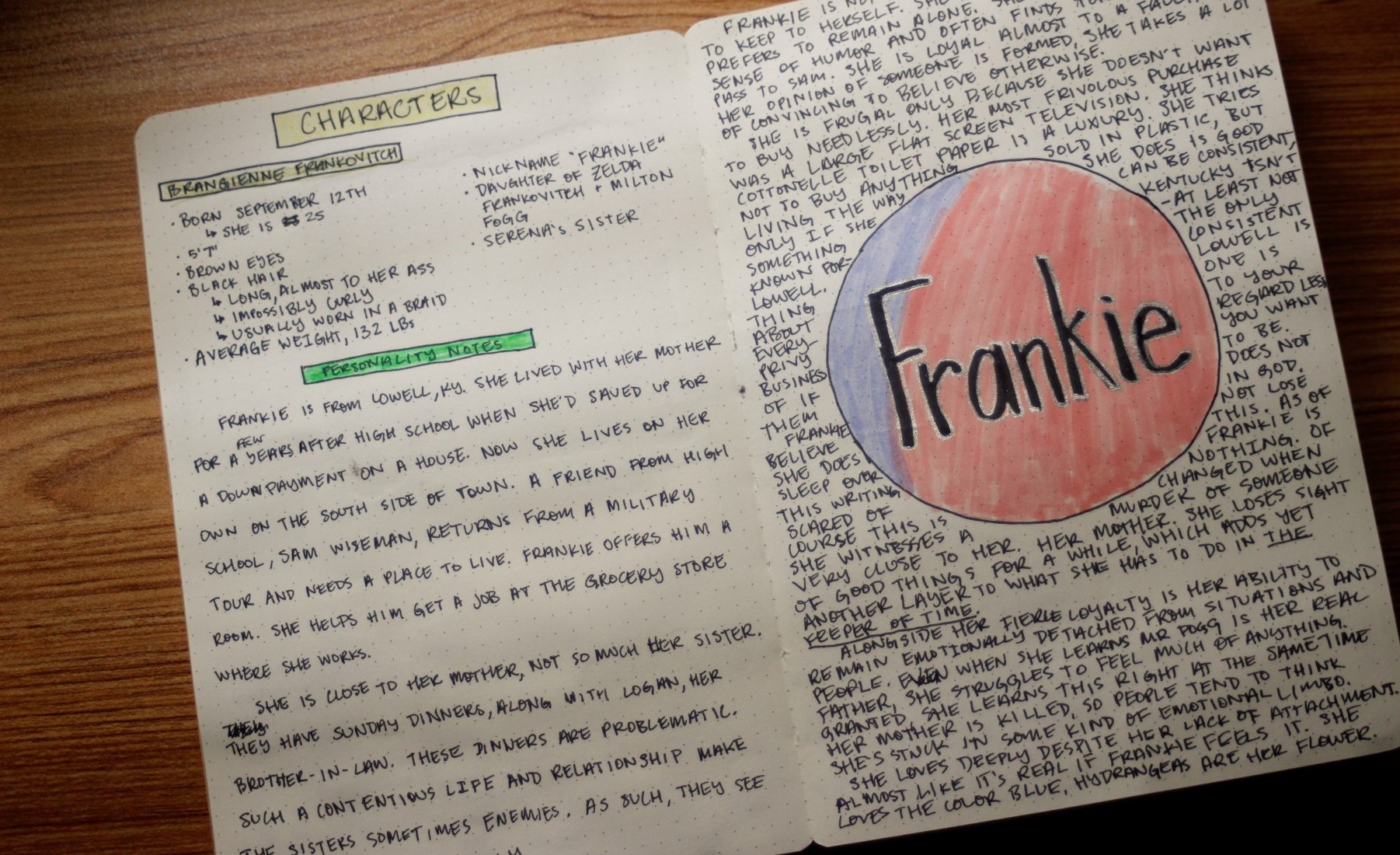
From My Journal – Character Sketch

This week, we’re going into my world building journal and taking a look at the main character of my Maker trilogy, Frankie. There are a lot of traits in her that I have myself, but that’s the truth of almost all writers. Injection of our best and worst qualities feels like the thing one does when one tells stories.

Brangienne “Frankie” Frankovitch

  • Born September 12th, at the time of the story, she is 25 years old.
  • 5’7″
  • Brown eyes
  • Black hair (long, almost to her hips, impossibly curly, usually worn in a braid)
  • Average weight, about 132 pounds
  • Daughter of Zelda Frankovitch
  • Sister to Serena Shorn

Frankie is from Lowell, KY. She lived with her mother for a few years after high school when she’d saved up for a down payment on a house. Now she lives on her own on the south side of town. A friend from high school, Sam Wiseman, returns from a military tour or two and needs a place to live. Frankie offers him a room. She helps him get a job at the grocery store where she works.

She is close to her mother, not so much her sister. They have Sunday dinners, along with Logan, her brother-in-law. These dinners are often emotionally explosive between Serena and Zelda. Such a contentious life and relationship makes the sisters sometimes seem like enemies. As such, they see each other infrequently.

Frankie is not an overly loud person. She tends to keep to herself. She isn’t anti-social, simply prefers to remain alone. She has a very dry sense of humor and often finds terrible jokes to pass to Sam while they’re supposed to be working. She is loyal almost to a fault. Once her opinion of someone is formed, she takes a lot of convincing to believe otherwise–both in a positive and negative way.

She is frugal only because she doesn’t want to buy needlessly. Her most frivolous purchase was a television. She thinks Cottonelle toilet paper is a luxury. She tries not to buy anything sold in plastic, but living the way she does is good only if she can be consistent, something Kentucky isn’t known for–at least not in Lowell. The only thing consistent about Lowell is everyone is privy to your business regardless of if you want them to be.

Frankie does not believe in God. She does not lose sleep over this. As of this writing Frankie is scared of nothing. Of course this changes when she witnesses a murder of someone close to her. Her mother. She loses sight of good things for a while, which adds yet another layer of what she has to do in The Keeper of Time.

Alongside her fierce loyalty is her ability to remain emotionally detached from situations and people. Even when she learns who her father is, she struggles to feel much of anything. Granted, she learns this right at the same time her mother is killed, so people tend to think she’s stuck in some kind of emotional limbo. She loves deeply despite her lack of attachment. Almost like it’s real if Frankie feels it.

She loves the color blue, and hydrangeas are her favorite flower.

The Girl Who Said Goodbye

This week we’re doing something a bit scary for me. I don’t often share my writing publicly because it’s often something I consider too personal. Good approach if I want to get published one day, huh? Anyway, this is a piece I’ve worked on off and on for a little while. It’s about death and the afterlife, so if that is something you find troublesome, please skip this post. Otherwise, I hope you enjoy it.

A dry hacking sound tore through the house. From under the covers on a crumbling bed, a papery hand reached for the glass on the table, fingers trembling on its smooth, cool surface. Empty. Frederic knew it was, but with everything, he’d forgotten. He coughed again. A fit overtook him and if he could have crawled to the bathroom to spit the blood, he would have. Sunken with age, his chest heaved as he tried to get a full breath of air. The coughing died to a steady wheeze with each shallow pass.

Something clattered on the stairs. Fear froze his stomach. He cried out, a pathetic, weak sound, and covered his face.

Someone burst into the room, shattering the warped wood of the frame. A woman with matted and tangled black hair staggered in. Paler than a sun bleached mouse skull. Her coat, an army green thing, shredded to her elbows with strips of mangy fabric dangling as she searched the room. She dug into the pocket of her khaki colored trousers, a small notebook in her hand. She flipped through it as she studied the room, nodding to herself. Her eyes landed on the lump on the bed.

At first, Frederic thought she was there to rob him. She certainly looked the part. No shoes. Tear stains left salt crusted trails down her cheeks through the dried muck smeared on her skin. He watched her as closely as his tired eyes would let him. A quiet beep made her check her wrist. She looked at him, her eyes suddenly clear, a bright green piercing him with kindness. She smiled and the fear left him.

“Will you open the curtains?” Frederic gestured to the window. His voice cracked like dry leaves on a sidewalk. “The curtains.”

She shook her head. When she spoke in English, his shoulders seemed to sink into the mattress further. Her eyes closed and she tipped her head back, as though trying to remember.

“Je suis desole,” she said, her accent marring the fluidity of his language.

He nodded and pointed, the weight of his arm almost crushing his chest. “Please.”

She went to the window and waved at the heavy fabric. “Oui?”

He nodded once more. She pulled one side over, and then the other. A sigh deflated him.

“It has been three days since I’ve seen them, the stars.” He tucked his hand under his cheek and smiled, his watery blue eyes bright. Tears slipped over his nose, but he didn’t bother to wipe them. “I have not seen–“

She sat on the bed by his knees as he wept what was left of his tears. The sound of his dying filled the silence. No death rattle, simply weary breathing. The woman remained on the edge of the bed for a while after he inhaled one last time.

She wasn’t ready for the next part. She never was. With a shuddering sigh, she shook herself from her head to her toes and cracked her knuckles. The soul was in there, waiting. She could feel it radiating from just below his ribs. Not quite the stomach, but just above it.

“Let’s get you home,” she whispered and stroked his cheek.

Her body trembled as she looked into the ceiling, her eyes going completely white. Offering a quick word of what could have been a prayer, her form shifted into an ethereal translucence, making her look almost dead herself. She plunged her fist into his chest. If she’d been solid, she’d have snapped his ribs. But she didn’t need a body for this.

One more deep breath and a hard yank. She held his soul, its tendrils spilling over the palm of her hand, trying to fill the body below once more. She gently folded it together and eased it into her satchel. She touched his forehead, a sad smile on her cheeks. His eyes remained open. He’d been without the stars long enough.


The woman, Gabriel, clambered down the stairs, her form solid again. She made sure to leave the door open, something she always did for those like Frederic. Pausing, she looked back up at the bedroom window. She blew him a kiss as she backed out of the front gate, past the delphinium and hyacinths, the tall wild grass choking the fence. She sent one more kiss his way, and waited, her hand at her throat, as though she could stop the weeping behind her teeth. She wiped her nose on her dirty sleeve and stepped off the curb in front of the bus speeding toward the city.

It caught her as it always did and she swung herself up onto the roof. Flattening against the cold metal, she let herself become translucent once more, part of the heat emanating from the warm bus inside. A shimmer passing by. She held her satchel closer, remembering the man she held. Hoping they’d find him soon.

Fifteen minutes later, she let herself slip from the rooftop and land on her feet beside a bus stop. She plopped herself down on the bench and sighed as she rubbed her eyes. Getting back to the underworld wasn’t the difficult part, but she always hated the sensation of leaving behind part of herself every time. A few deep breaths later, she clenched her fists and gave over to the pull all souls feel from the beyond.

It dropped her at the entrance, similar to the way grand hotels looked from the inside, the afterlife’s way of giving the departed a peaceful sendoff. She pushed open the door and stepped onto the street. The hazy gray light bounced off of empty, dilapidated buildings. Her feet knew the way, and she let herself get lost in her thoughts as she made her way to her final destination.

She loved them, those creatures she carried. They represented the good of the world she’d left behind all those years ago. Her task to give the souls their last bit of love before they rejoined the stars in the underworld sky made it less challenging. Often she’d be whisked from place to place, though. Too many died alone, and she couldn’t let that happen.

But she found them. All the same. She found them at each and every bedside, each broken bridge, the crumbled stairs in buildings long abandoned. They wandered without someone to hold them in, those souls, never straying too far, however, from their bodies. Just in case.

Gabriel knew she had the job no one else wanted. It was most difficult on a day with suicides, car accidents, and stillborns. But she treasured those souls a little more. Carried them in special paper she’d designed from the sea kelp to keep them from getting crushed by the others in her bag. Some of the gatherers didn’t like souls. Found them too alien. Smoke monsters, she’d heard them called. But there was nothing monstrous about them.

They all mattered. Every single one of them. Who else would show them a final act of kindness before they left? Certainly, she was lonely. No one talked to her much after they learned how long she’d been assigned to this task, how she asked to be left on it. The veterans accused her of enjoying the death. The loss of life.

It was quite the contrary, of course. Gabriel felt the life in each soul she emancipated from its husk. The joy. The sorrow. The anguish, the moments of love—all of it. Purer than the way a baby smiled at her mother for the first time.

The smell of salt made her lift her head. She turned down a side street and kept going even past the brick wall blocking off what lay beyond it. Special privilege for gatherers and all. She pushed through a heavy gate, the rusted hinge finally cracking off—salt water made short work of that. No one came here. Not anymore. The monocrhome waves of the TV static left bitter aftertastes in their mouths.

She sat slowly at the edge of the water, a grimace smudging her face as she scooted closer to the sea. It hurled itself at her.

It knew of her prize.

“I know, I know,” she said, petting it like a cat. She opened her satchel and pulled out the soul. Shaped like a dome, it wobbled in her palms, going dull in the black and white of the shore. All souls did. She blew on it a little, the tendrils floating when she stopped.

The sea waited. She lowered her cupped hands into it. As soon as Frederic’s soul touched the static, millions of others lit up the sea all the way to the horizon. A low hum resonated in her chest as he drifted away, the water like seltzer on her toes. She smiled.

If your bones be heavy things,
lay yourself down at my feet.
I will bring you safely home,
wherever it may be.

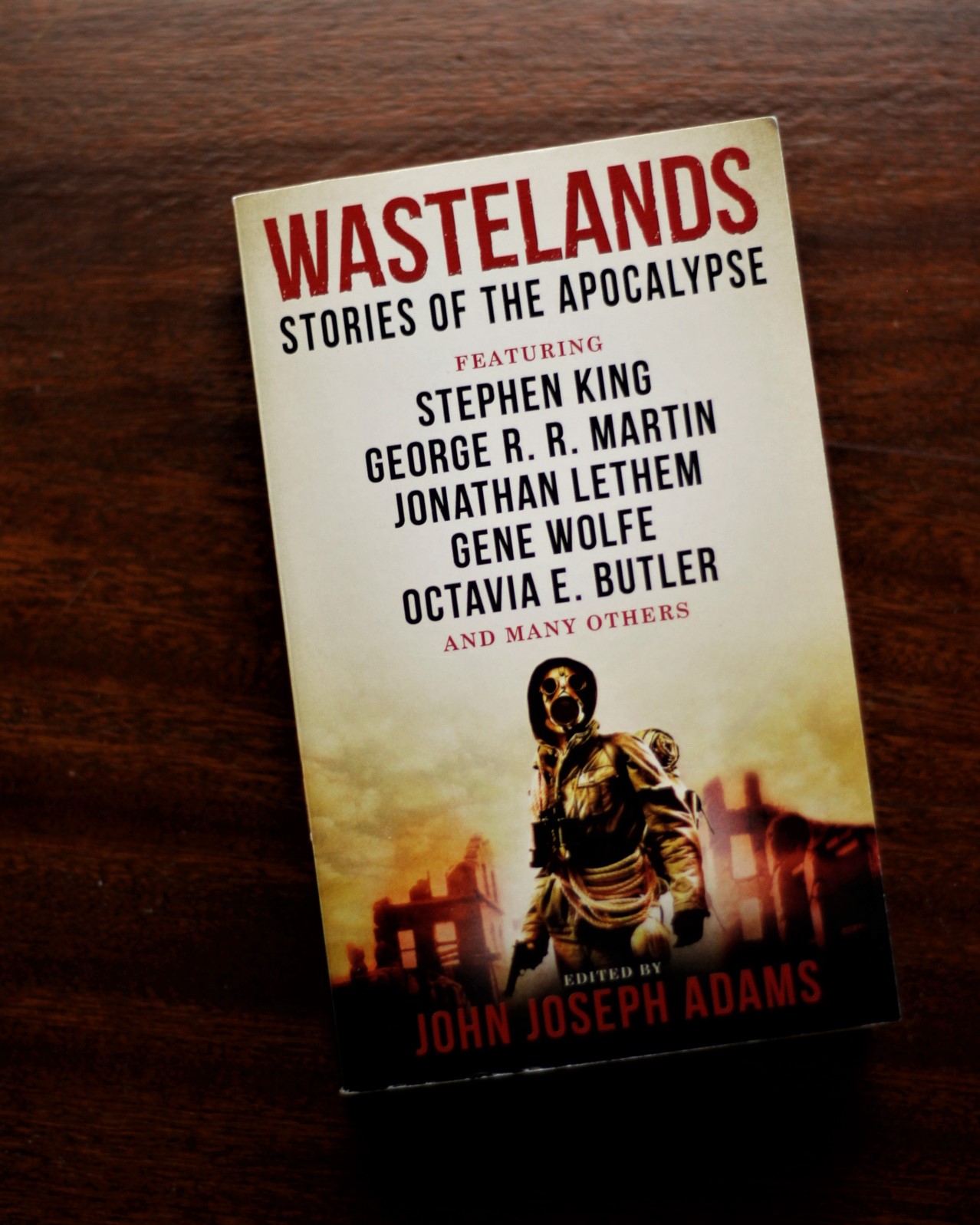
Wastelands: Stories of the Apocalypse, edited by John Joseph Adams

Hey. How’s it going? Doin’ all right? Weather’s getting nicer. Finally. Today we’re talking about a collection of stories I picked up as research for some of my own work, and eventually just read it for enjoyment. Everyone has an apocalypse theory. A reason for why the world will end. Plague, natural disaster, humanity eating itself. Endless possibilities. It’s difficult to write a review for a collection of stories as a whole book, so I’m going to give my thoughts on the ones that stood out to me. The big draws for this book are obviously Stephen King and George R. R. Martin, but only one of those big names had a story that stood out to me. So, let’s get in to it.

There are 22 stories in this collection, and I’m going to touch briefly on eight of them. These are the ones that I’d consider the better of the tales being told, but that’s not to say the others don’t have their merit. My preferences tend to be on the more emotional side, the more “hit in the feels” kind of storytelling. That said, the opener for this was Stephen King’s, and I felt nothing for it. He’s not someone I actively seek out to read, and that’s not me trying to say he’s a bad author. He has a massive fanbase, and my opinion is more like a bloop in the ocean. My first choice of story that stood out, hah, is:

Dark, Dark Were the Tunnels by George R. R. Martin
This story centers on Greel. Greel is a man. He’s what’s left of humanity on Earth after the apocalypse forced most others off the planet. But the others have come back. What happens is a misunderstanding of the new life on a radiation ravaged planet, where life began anew underground. It feels almost like a commentary on the differences between cultures being mistaken for aggression, and instead of waiting to figure out a compromise or a way to communicate, it escalates to fatal proportions. It does have an expected feel to it, where as reading it becomes fairly obvious what’s going to happen, but I still found myself thinking about it after I’d finished. One of the things I like about Martin’s style is his descriptions. He’s very good at showing exactly what he wants you to see. I give this story an 8/10.

Waiting for the Zephyr by Tobias S Buckell
Mara is the girl who knows there’s more to life than her small town offers, and this story is all about that hope. One of the shorter stories in the collection, that doesn’t take away from the power of that hope. This story deals with expectations of small town life (I say small town, but really it’s more like a spot of life in a desert), and the ambitions of someone not willing to be tied to that life. It’s written well, and Mara is memorable. I give this story a 9/10.

Never Despair by Jack McDevitt
Another short piece of the collection, this is almost on the same level of optimism as “Waiting for the Zephyr.” It follows Chaka as she goes in search of answers. The world’s ended, obviously, and she wants to find out more, to understand what happened to those who’d gone before. Chaka talks to a projection of Winston Churchill, and they have such a charming conversation. That may sound sarcastic, but I don’t mean it to be. It’s really almost like a granddaughter telling her grandfather about her day at school. It’s in this story that my favorite quote of the book can be found: “The turnings of history are never directed by crowds,” he said. “Nor by the cautious. Always, it is the lone captain who sets the course.” I give this story an 8/10.

Artie’s Angels by Catherine Wells
This is the first one that kind of made me sit back and contemplate life for a while. It’s about a rough neighborhood and turf wars (that’s my very basic level description, it’s more than that), and a hero trying to live out a dream. It’s got the desperation for something more than what the world is offering, the frustration at never being enough for that success, and just so much more to it. By the end, I wanted to spend time with the people who matter to me. To ease the loss of something that wasn’t real in the first place. I give this story a 9/10.

Inertia by Nancy Kress
Holy balls, this one knocked me backward. It was a bit predictable in some places, but by the end of it, I was ready to go to war and fight battles for people that didn’t exist. It’s the story of an old woman in a neighborhood cordoned off for being a colony of diseased people at the end of the world. There’s lots of talk of “before,” and there’s lots of talk of how to make life better for everyone inside the colony. The best line from this story is, “She cannot change the world. It’s too old, too entrenched, too vicious, too there. She will fail. There is no force stronger than destructive inertia.” I give this one an 8/10.

Speech Sounds by Octavia E Butler
I feel like when Adams was putting this collection together, he saved the best stories for last, because this one is almost perfect. It takes a look at the scenario almost like the Tower of Babel from the Bible, where language fails at the end of the world, so no one knows how to speak properly or really communicate well. Grunts and hand gestures mean different things to different people. There’s no real way to say what is meant. Except for the main character, Rye. She can speak, which is a rare thing and seen as dangerous. It’s something she keeps to herself. The story would be perfect if there weren’t a lag in the later quarter of it. I give this story a 9/10.

The End of the World As We Know It by Dale Bailey
This story is almost meta in the way it calls itself out for being a story about the end of the world. It approaches the topic from the point of view of a lone survivor of some mysterious thing that’s caused everyone to die. He roams the leftover world to find something of a purpose, and it’s just pure desolation. I like this one because it gives a bit of a different perspective on apocalypse stories while still being cliche at places. I give this one a 7/10.

A Song Before Sunset by David Grigg
In the whole collection, no story ever made me close the book and set it aside because of the despair the apocalypse usually brings. Until this one. I would have cried if I’d let myself think about it too much. It follows Parnell, a man who lives by himself in a rundown city. It’s rough, as these stories are, but for Parnell, he tries to hold onto the beautiful things. The books, the art, the music–all past things now essentially obsolete because no one has a need for beauty in a broken, dead world. Parnell finds a way to get into a concert hall where a grand piano is waiting on the stage for him. He used to be a pianist. He trades with a kind of “general store” merchant, the Tumbledown Woman, for tools to repair this piano. And he plays it. There is a huge undercurrent of “what do we do with the beautiful things when the world ends?” running through this, and it is an excellent question. Because there will always be reason to hold on to the beauty, the bits of the past that aren’t useless, not entirely. But there will also be a need for necessity. It becomes a delicate balance of what is needed for survival and what is not. Practicality over frivolity. This story felt the most apocalyptic to me. I give this one a 10/10.

Episode Seven: The Last Stand Against the Pack in the Kingdom of the Purple Flowers by John Langan
The last story in this collection was one of the more interesting stylistically. I’ve never read work by most of the people in this, but I was not prepared for this one. Written entirely in one sentence over the course of forty pages, I was ready to hate this. Episode Seven is about a woman and her best friend running away from a pack of hyenas (maybe hyenas? I don’t think it was fully said they were hyenas, but they were animals like hyenas). These animals are smart and tracking them through all kinds of terrain, and all kinds of metropolitan destruction. There’s an added level of fear for her because she’s also pregnant and nearing the end of her pregnancy. Her best friend, Wayne, somehow knows all the things he has to do in order to help them survive in the busted up world. But there’s something not quite right about him. Something has been off the entire time, but she’s been unable to figure it out. I loved the ending of this story, and by the time I’d reached it, I hadn’t paid too much attention to the punctuation situation. This was a fun thrill ride of a final story, and I think it gets an 8/10.

*******I read the 2015 Titan Books paperback edition*******